After factual report problems are separated from accurate balances, use the debt repayment order guide to decide how current obligations should compete for extra cash.
A credit score summarizes information in a credit report. It does not tell you whether the underlying information is accurate, which account created the change, or what action has the highest priority. Credit triage starts with the reports, not the score.
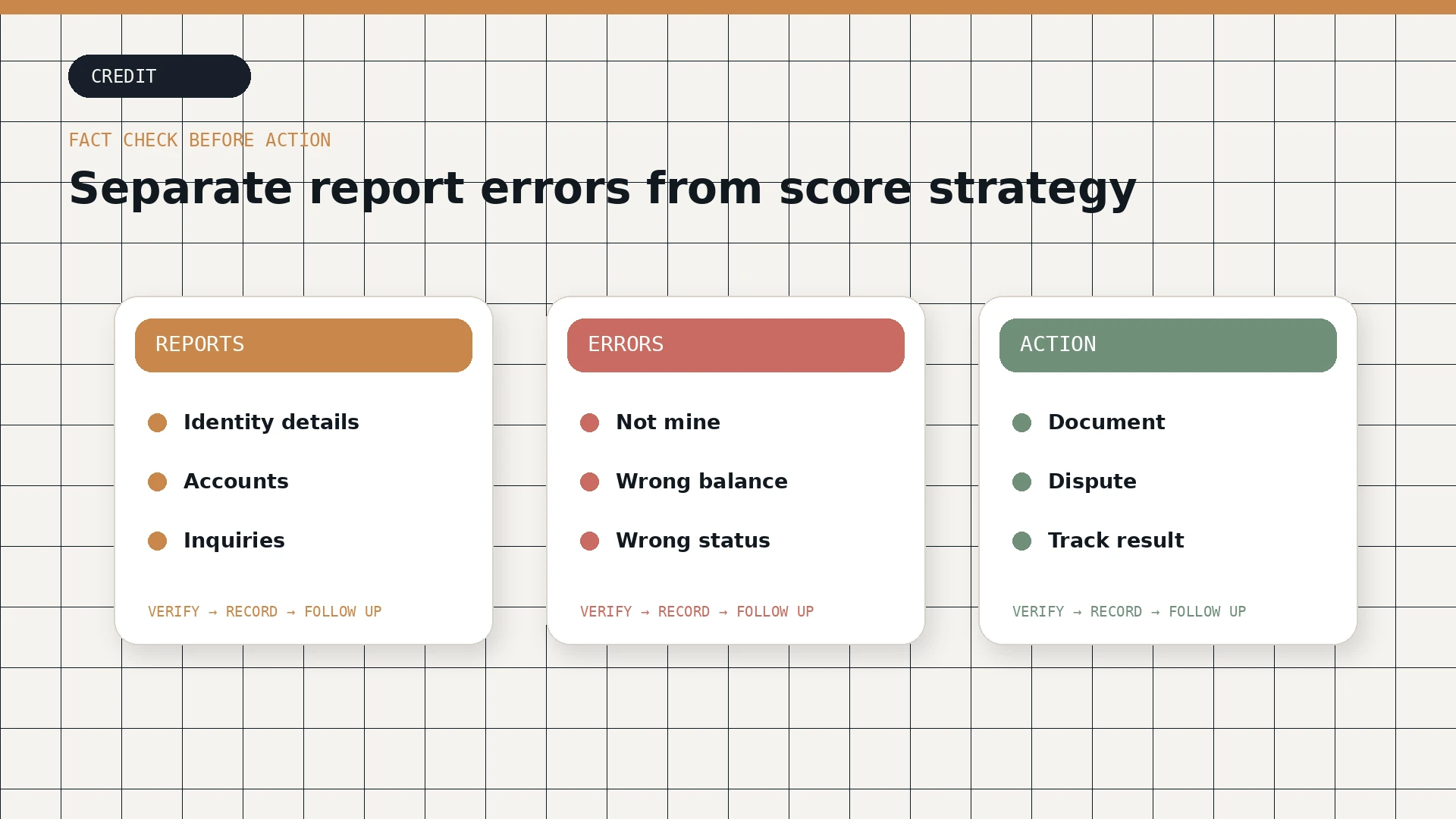
The process has four lanes:
- Identity and ownership
- Account accuracy
- Payment protection
- Balance and utilization strategy
Mixing them creates wasted effort. Paying down a card does not correct an account that is not yours. Filing a dispute does not replace an affordable plan for an accurate balance.
Gather complete reports and supporting records
Review reports before a major credit application, after signs of identity theft, after a creditor says it reported information differently than expected, and periodically as part of normal financial maintenance. Save the date and source of each report because the same account may appear differently across reporting companies.
Gather statements, payoff letters, account-opening records, payment confirmations, settlement documents, bankruptcy or court records when relevant, and prior correspondence. Do not send original documents when a copy is sufficient.
Lane 1: verify identity and ownership
Start with names, addresses, employers, and identifying information. An old address is not automatically an error, but unfamiliar information can help reveal a mixed file or identity problem.
For every account, ask:
- Is it mine?
- Is the account number or partial number recognizable?
- Is the creditor or collector name connected to a known account?
- Are authorized-user and joint-account roles correct?
- Is the open or close date plausible?
If an account may involve identity theft, use the dedicated identity-theft process rather than treating it as an ordinary balance dispute.
Lane 2: verify account facts
Review status, balance, credit limit, payment history, delinquency dates, collection status, and remarks. Focus on factual differences that can be supported.
Common issues include:
- Account does not belong to you
- Same debt appears more than once without a clear transfer relationship
- Balance or limit is wrong
- Account is shown open after closure
- Payment is shown late despite proof it was received on time
- Delinquency date is inconsistent
- Authorized-user status is wrong
- Information is too old under the applicable reporting rules
A disagreement with the effect of accurate information is not the same as a factual error.
What kind of credit problem did you find?
Preserve the report, check for identity theft, and use the appropriate fraud and dispute process.
Document the correct fact and dispute the exact field with the reporting company and/or furnisher.
Protect current status and contact the creditor before another payment is missed.
Move to utilization, debt sequencing, and application timing.
Build a precise dispute file
A useful dispute identifies the report, account, field, reason, and requested correction. “This is wrong” is harder to investigate than “The report lists a 30-day late payment for May; the attached statement and confirmation show receipt before the due date.”
Keep:
- A copy of the report with the item marked
- The dispute letter or online submission
- Supporting documents
- Submission confirmation
- Dates and tracking information
- Investigation result
- The updated report
The CFPB explains that disputes can be sent to the credit reporting company and the company that furnished the information. Follow the current official instructions and deadlines. Avoid paying a third party to submit a dispute you can document yourself unless you understand exactly what service is being provided.
Protect payment status during the process
A dispute does not automatically make future payments optional. Continue affordable required payments or obtain a written hardship arrangement. If a creditor agrees to change the due date, payment amount, or status, confirm how it will report the account.
When cash flow is under pressure, use the 30-day triage plan so a report correction does not occur alongside new avoidable delinquencies.
Handle utilization after the facts are correct
Utilization generally compares reported revolving balances with credit limits. It can change even when spending is paid in full because the reported balance may reflect a statement date or other reporting cycle.
Use utilization as a cash-flow and application-timing issue, not a reason to make unnecessary purchases or carry interest. Practical actions can include:
- Reduce revolving balances when affordable
- Pay before the balance is reported when timing matters
- Avoid closing an account without considering fees, risk, and total available credit
- Avoid opening several accounts merely to change a ratio
- Keep emergency savings and required bills protected
Match the action to the report
| Scenario | Best for | Upside | Main trade-off | Next step |
|---|---|---|---|---|
| Identity error | Account or personal information not yours | Can remove unrelated risk from the file | May require fraud documentation and repeated follow-up | Preserve evidence and use identity-theft procedures |
| Status error | Wrong late payment, balance, limit, or account state | Corrects the factual record | Requires precise documents and tracking | Dispute the exact field and keep the result |
| Accurate high balance | Utilization or debt load is the issue | A payment plan improves both cash flow and reported balances | Progress depends on available cash | Choose a repayment order and model the payoff |
| Thin or limited history | Few active accounts or short history | Time and consistent payment can strengthen the file | There is no instant fix | Avoid unnecessary applications and keep accurate accounts current |
Recheck the result
After an investigation or creditor correction, obtain and save the updated report. Confirm that the exact field changed and that the correction appears where expected. If the result does not address the evidence, review the explanation and current escalation options rather than resubmitting the same vague claim.
Do not assume that a corrected report immediately produces a specific score change. Scoring models, timing, and the rest of the file matter.
Turn the page into action
Complete a credit report triage
- Save current reports and record their dates and sources.
- Verify identity details, account ownership, status, balances, limits, and payment history.
- Separate factual errors from accurate debt or utilization issues.
- Submit a precise dispute with copies of supporting documents.
- Protect current payments or obtain written hardship terms during the process.
- Save the result and verify the corrected report.
Evidence to action
Methods and evidence
Structured datasources.jsonformulas.jsonsystems.json
Evidence
Sources
- When should I review my credit report?
cfpb-credit-report-reviewConsumer Financial Protection BureauAccessedAugust 18, 2026
- How do I dispute an error on my credit report?
cfpb-credit-disputeConsumer Financial Protection BureauAccessedAugust 18, 2026
- How long does it take to repair an error on a credit report?
cfpb-credit-repair-timingConsumer Financial Protection BureauAccessedAugust 18, 2026
- Understand your credit score
cfpb-credit-scoreConsumer Financial Protection BureauAccessedAugust 18, 2026
Common questions
Frequently asked questions
Should I dispute every negative item on a credit report?
Dispute information that is inaccurate, incomplete, duplicated, outdated, or not yours. A dispute is not a method for removing accurate negative information. Keep records and explain the specific factual error.
Does lowering utilization fix report errors?
No. Utilization is a balance-management issue. An account that is not yours, has the wrong status, or reports an incorrect balance requires a factual review and, when appropriate, a dispute with supporting documentation.
Should I pay a disputed balance before the investigation is complete?
Payment decisions depend on the contract, account status, and risk of additional fees or collection activity. A dispute does not automatically pause every obligation. Confirm the process with the furnisher, reporting company, or a qualified adviser.