A caller says your phone number is linked to crimes abroad and will be disconnected unless you cooperate. The FTC’s October 22 consumer alert describes that threat as a government-impersonation scam. The caller may supply a badge number, transfer you to a supposed police officer, or direct you to search for a number to call back. The later demand is money for a supposed security deposit.
The useful lesson for a household is about control of the contact route. Ending the first call is a good start, but calling a number selected by the same person can return you to the same scheme. Use an independently chosen contact before taking any account or payment action.
What the new alert describes
The FTC says the impersonator claims a phone was registered using your name and number and is being used for scams in another country. A fake employee ID and a supposed police transfer make the story appear official. The caller then seeks identification and other personal details, demands secrecy, and escalates to an arrest threat and a payment demand. This is the sequence described in the alert, not a new power for the FTC to disconnect phones.
The agency says its employees do not threaten to disconnect your phone, demand money, tell you to keep the conversation secret, or send an employee-ID photo by text to prove who they are. You do not need to settle the story with the caller. End the conversation without paying or supplying more information.
Ask who chose the callback number
A callback is useful only when the route is independent. In this alert, the scammer can tell the person what to search for, so the apparent verification call is answered by someone in the scheme. A convincing result, badge number or second voice is not enough to establish identity.
The FTC’s government-impersonation guidance also warns that caller ID can be faked. If you need to check a real account issue, start from an official website you locate independently, a saved trusted contact, the provider’s known app or contact details on your own statement. Do not use a link, number or search instruction supplied by the threatening caller. For an actual phone-service concern, contact your carrier through its established account channel.
Make a household callback card
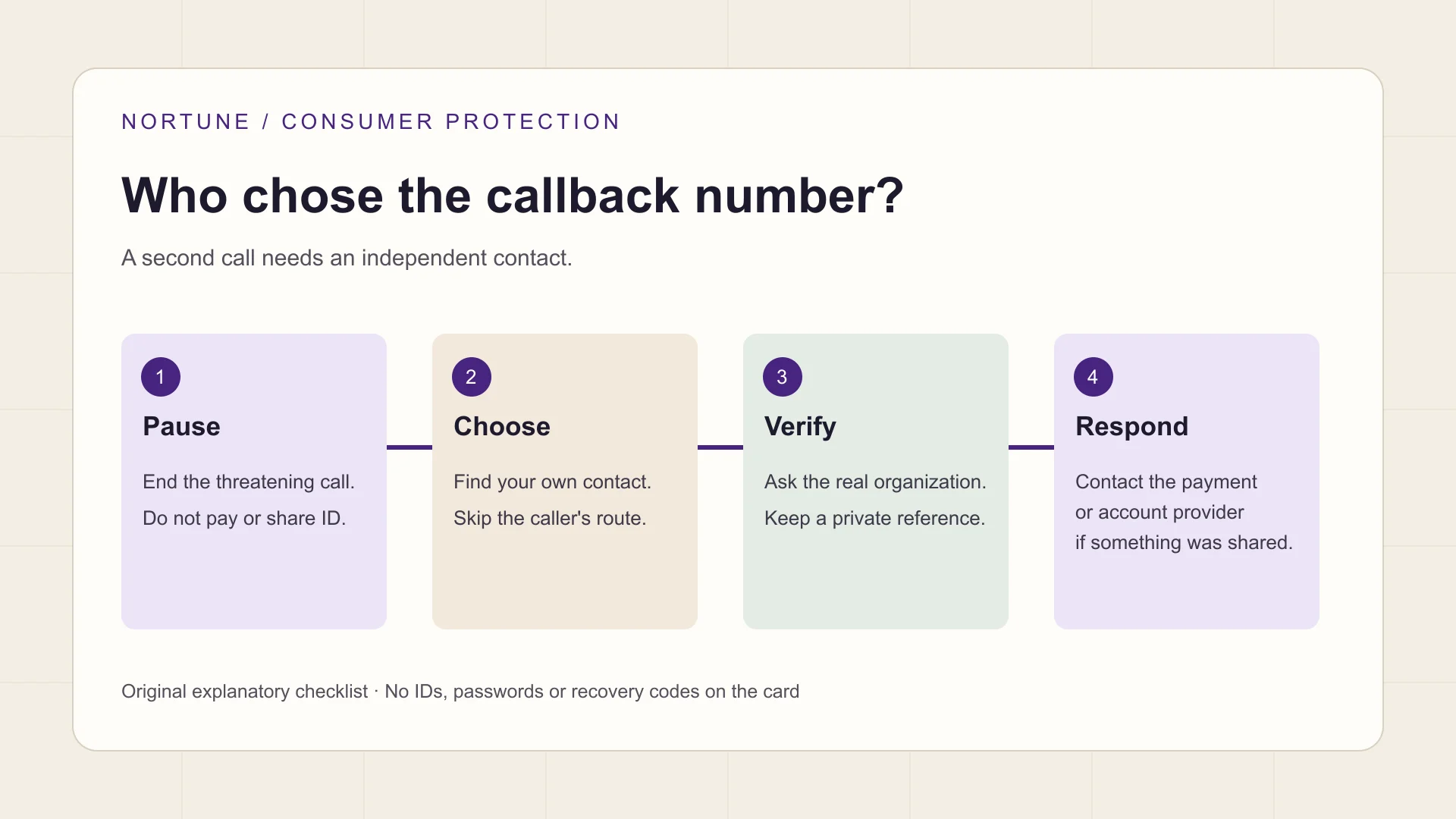
The following is Nortune’s practical handover checklist, not an FTC form. It turns the alert into a repeatable process without recording secrets. Keep it with your financial emergency binder so a household member does not have to improvise under pressure.
| Step | Action | Safe note to keep |
|---|---|---|
| Pause | End the call. Do not send money, share ID or follow a transfer. | Time and the claimed agency; no passwords or identification numbers. |
| Choose | Find your own trusted agency, bank or carrier contact. | Where you independently obtained the contact. |
| Verify | Ask the real organization whether an account issue exists. | Case reference and next step, if one is actually provided. |
| Respond | If money or information was exposed, contact the relevant provider promptly. | Report date, reference and follow-up reminder. |
Agree in advance that anyone can pause a suspicious call and consult a trusted person. Treat a demand for secrecy as a reason to stop. The card should point to secure records, not contain copies of IDs, account credentials or recovery codes.
If you already shared money or information
Use the FTC’s recovery guidance for the actual payment method. Contact your bank or card issuer immediately for a bank or card payment, the payment app for an app payment, or the gift-card issuer for a gift card. Explain that a scammer induced the payment and ask whether it can be reversed or refunded. Keep receipts and references. Recovery is not guaranteed, and reporting is not a promise of reimbursement.
If login details were shared, follow the real provider’s recovery process, change compromised passwords and enable multifactor authentication where available. The FTC’s phishing guidance explains why an existing relationship with a company does not make a message trustworthy. If identity information was exposed, use the official IdentityTheft.gov guidance for your situation; a credit-report check alone does not secure a compromised account.
Report it without continuing the conversation
Report the attempted impersonation at ReportFraud.ftc.gov. Keep a private record of what happened and the actions taken; do not publish your identification or financial details to seek help. If a credit file contains an unfamiliar account or an error, our credit-report triage guide separates an identity-theft concern from an ordinary reporting dispute.
This article explains a US FTC alert and the agency’s recovery resources. A caller invoking the FTC does not establish a US legal obligation for someone in Puerto Rico, Japan or elsewhere. For local matters, use the relevant organization’s official channel. Nortune has not contacted a scammer, tested a carrier account or verified an individual case.
Evidence
Sources
- The FTC is not calling to deactivate your phone number
ftc-phone-deactivation-alert-2026Federal Trade CommissionPublishedOctober 22, 2026AccessedOctober 25, 2026
- How To Avoid a Government Impersonation Scam
ftc-government-impersonationFederal Trade CommissionAccessedOctober 25, 2026
- What To Do if You Were Scammed
ftc-scam-recoveryFederal Trade CommissionAccessedOctober 25, 2026
- How To Recognize and Avoid Phishing Scams
ftc-phishing-preventionFederal Trade CommissionAccessedOctober 25, 2026
Common questions
Frequently asked questions
Does a badge number or police transfer prove the call is real?
No. The FTC’s October 22 alert describes fake badge details and a transfer to a supposed police officer. End the call and independently contact the real organization if you need to check a concern.
Is a callback safe if the caller tells me what to search?
That is not independent verification. In the described scheme, the instructed search leads back to people involved in the scam. Choose a trusted contact without using the caller’s number, link or search directions.
Will reporting to the FTC get my payment refunded?
Reporting does not guarantee a refund. Contact the relevant bank, card issuer, payment app or gift-card issuer promptly, describe the scam and ask what recovery is possible. Keep receipts and case references.