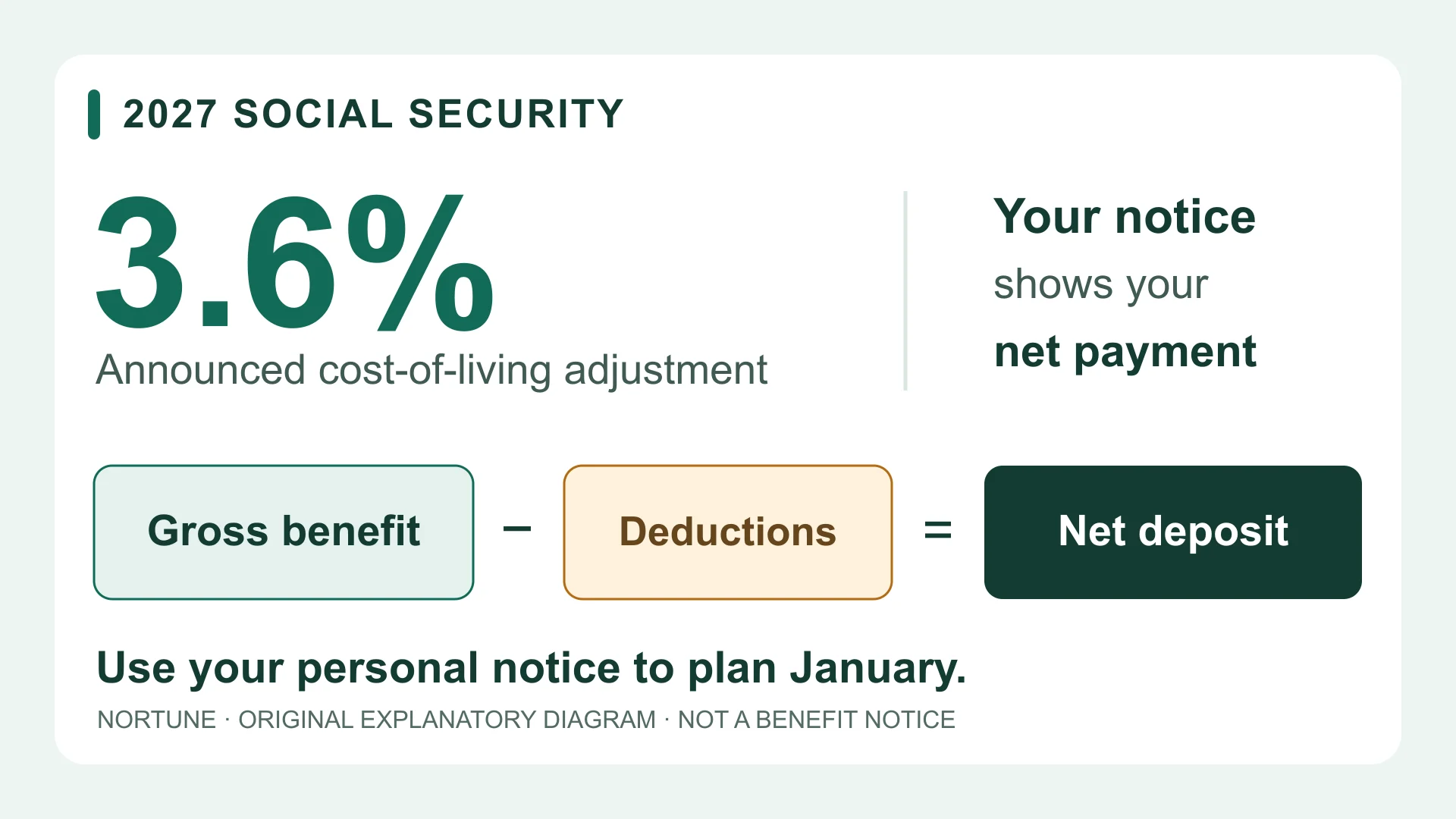
The US Social Security Administration announced its 2027 cost-of-living adjustment on October 14. For a household receiving benefits, the next useful step is to identify the amount that will reach the bank and the date it can fund bills. The announced percentage alone cannot answer either question for an individual.
The 3.6% increase is not a personal deposit estimate
SSA’s 2027 fact sheet reports a 3.6% COLA and an estimated average retired-worker benefit rising from USD 2,095 to USD 2,170 per month. That USD 75 difference is an average, not a flat increase promised to every recipient.
There is a second distinction: the benefit amount and the deposit are different budget inputs. SSA applies COLA to the primary insurance amount, with rounding and subsequent benefit calculations; deductions, including applicable Medicare premiums, affect the payment. Simply increasing the current bank deposit by 3.6% does not reproduce that process.
Keep an estimate separate from confirmed income. This article does not quote a 2027 Medicare premium or calculate an individual’s entitlement. If the new deduction is still unknown, leave that input unresolved rather than carrying forward a convenient number and treating the result as final.
Dates that matter for the budget
The SSA effective-date explanation separates the benefit month from when payment occurs. Use that distinction when labeling a calendar entry.
| Item | Timing | Budget treatment |
|---|---|---|
| Social Security benefit with the new COLA | December 2026 benefit, payable in January 2027 | Use your own payment date, not January 1 by default. |
| January 2027 SSI payment, if eligible | December 31, 2026, because January 1 is a holiday | Label it January income received early, not an extra monthly benefit. |
For the personal notice, SSA says online availability begins in late November, with mailed notices in December. If you do not already have an account, create one and enroll in paperless notices by November 18 to see the notice online, following the agency’s announcement. This article cannot establish a reader’s access, eligibility or payment date.
Turn the notice into a usable plan
When your notice arrives, make one dated entry for each benefit you actually receive. Keep the notice with your private records; there is no need to send personal benefit information to Nortune.
- Record the gross benefit. Copy the amount from your own notice. Label it gross so it is not mistaken for money available to spend.
- Record the deductions separately. Use the deductions shown for your payment. If something is missing or unclear, flag it for clarification instead of silently assuming zero.
- Record the resulting net payment. This is the expected receipt for the household cash plan. Keep any estimate clearly marked until you have the individual figures.
- Attach the applicable payment date. Put the receipt beside the bills it must fund. A larger monthly total does not help a bill due before the money is usable.
- Reconcile the first deposit. Compare the received amount with your entry and resolve discrepancies through SSA’s official channels before building ongoing spending around the difference.
Do not add the gross increase as a separate income line while also replacing the old net receipt with the new net receipt. That counts part of the change twice. For a household with multiple recipients, keep each person’s payment distinct before totaling the money available for shared bills.
An early SSI payment needs a January label
If January SSI reaches the account in December, reserve it for the period it is intended to cover. Seeing two receipts in one calendar month does not by itself create another month of income. Check the January plan before treating the December balance as spare cash.
US program scope: SSI is separate from Social Security retirement benefits. Its general residence requirement covers the 50 states, District of Columbia and Northern Mariana Islands, not residents of Puerto Rico or Japan; limited exceptions and other eligibility conditions apply. Reading a translated article does not establish eligibility.
Update the budget with confirmed inputs
Use Nortune’s budgeting guide to assign the confirmed net income across required bills, irregular costs and other priorities. If payment timing remains uncertain, the dated cash-flow approach helps keep expected receipts apart from available cash. These are organizational steps, not advice about claiming benefits, changing Medicare coverage or filing taxes.
Editorial history: The displayed publication time, October 18, 2026 at 01:48:17 UTC, is an assigned recent date. This article was prepared and its sources checked on October 18 UTC (October 19 in Japan). The review date records source checking, not an independent financial review.
Evidence
Sources
- SSA announcement of the 2027 COLA
ssa-cola-2027-announcementSocial Security AdministrationPublishedOctober 14, 2026AccessedOctober 18, 2026
- 2027 COLA fact sheet
ssa-cola-2027-factsheetSocial Security AdministrationAccessedOctober 18, 2026
- Latest COLA and effective dates
ssa-cola-2027-effective-datesSocial Security AdministrationAccessedOctober 18, 2026
- Application of COLA to a retirement benefit
ssa-cola-calculationSocial Security AdministrationAccessedOctober 18, 2026
- SSI eligibility requirements
ssa-ssi-eligibilitySocial Security AdministrationAccessedOctober 18, 2026
Common questions
Frequently asked questions
Will my bank deposit increase by exactly 3.6% or USD 75?
Neither figure guarantees your deposit. USD 75 is SSA’s estimated average retirement benefit increase. Benefit calculations, rounding and your deductions determine the individual payment; use your own COLA notice for the budget.
Is the December 31 SSI payment an extra month of income?
No. For eligible SSI recipients, the December 31, 2026 payment is the January 2027 payment made early because January 1 is a holiday. Label it January income rather than an additional monthly benefit. SSI’s separate eligibility rules still apply.