Build the spending plan from money already available, then test future receipts as separate assumptions. Irregular income creates two questions: how much will arrive, and when can it actually pay a bill? An unpaid invoice is neither a cleared deposit nor permission to spend.
This guide uses US household-finance context and US dollars (USD). All dates and amounts in the worked example are hypothetical, not customer records, current earnings, or predictions. It does not establish tax rules, collection rights, or payment protections outside the United States.
Separate cash from promises
- Available now: cleared cash you can use, after excluding money already committed elsewhere. Do not count the same balance in two accounts, a transfer between your own accounts as new income, or a credit limit as cash.
- Scheduled receipts: income with an expected amount and date. These are still assumptions until received and available; a regular payer can also be late.
- Uncertain receipts: unpaid invoices, variable shifts, commissions, or other income whose amount or availability date is not reliable. Keep the expected date and a delay scenario separate from the cleared-cash column.
If your pay follows a dependable fourteen-day calendar, start with budgeting with biweekly pay. This guide instead tests a payment whose date is uncertain. For the underlying spending categories, use the monthly budgeting guide.
Build the dated ledger before averaging the month
Start with available cash. Place each expected receipt on its usable date and every expense on the date it must be funded. Keep holds, processing times, and payment cutoffs in mind. At each event, carry the prior balance forward:
B_t = B_(t−1) + I_t − O_t
B_t is the projected balance after event t; I_t is the receipt included in that scenario on that date; O_t is its planned outflow. All three are USD amounts. For a record of actual activity, use only funds actually received and available. The CFPB cash-flow worksheet similarly carries one week's ending balance into the next. Our example adds dated events so a weekly total does not conceal an earlier shortfall.
One invoice, three hypothetical scenarios
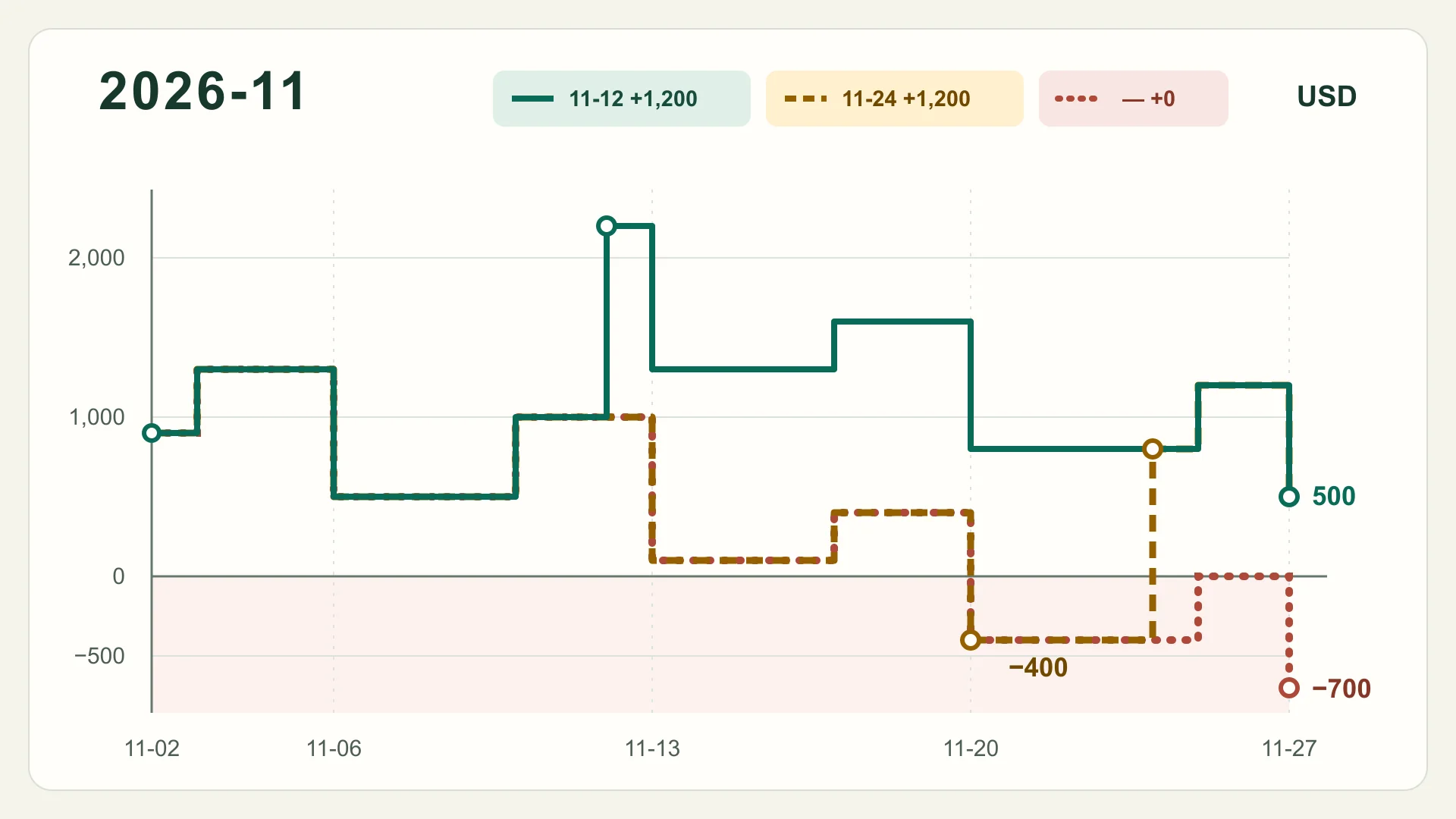
Assume USD 900 is cleared and available on November 2, 2026. Scheduled receipts are USD 400 on November 3, 500 on November 10, 300 on November 17, and 400 on November 25: USD 1,600 total. Those receipt dates hold in all three scenarios, but are assumptions, not guarantees. Planned household payments are USD 800 on November 6, 900 on November 13, 800 on November 20, and 700 on November 27: USD 3,200 total.
Separately, an unpaid USD 1,200 invoice is expected on November 12. Compare it becoming available on November 12, being delayed until November 24, or not arriving within the November 2–29 horizon. Count it exactly once in each paid case, and zero times in the uncollected case. The scheduled-flow column excludes this invoice; its conditional additions are named in their own rows.
Opening cash and receipts are assumed available for this household plan after any amounts reserved outside it. No borrowing, overdraft, interest, extra fees, tax rate, or other transactions are modeled. These deliberately simplified assumptions must be replaced with actual obligations and availability dates in a personal plan.
| Date | Event or assumption | Scheduled flow | Invoice November 12 | Invoice November 24 | Invoice not received |
|---|---|---|---|---|---|
| 2026-11-02 | Cleared opening cash: 900 | — | 900 | 900 | 900 |
| 2026-11-03 | Scheduled receipt, assumed available on this date | +400 | 1,300 | 1,300 | 1,300 |
| 2026-11-06 | Planned household payment | -800 | 500 | 500 | 500 |
| 2026-11-10 | Scheduled receipt, assumed available on this date | +500 | 1,000 | 1,000 | 1,000 |
| 2026-11-12 | Invoice +1,200 only in the November 12 case | — | 2,200 | 1,000 | 1,000 |
| 2026-11-13 | Planned household payment | -900 | 1,300 | 100 | 100 |
| 2026-11-17 | Scheduled receipt, assumed available on this date | +300 | 1,600 | 400 | 400 |
| 2026-11-20 | Planned household payment | -800 | 800 | -400 | -400 |
| 2026-11-24 | Invoice +1,200 only in the November 24 case | — | 800 | 800 | -400 |
| 2026-11-25 | Scheduled receipt, assumed available on this date | +400 | 1,200 | 1,200 | 0 |
| 2026-11-27 | Planned household payment | -700 | 500 | 500 | -700 |
On time: 900 + 1,600 + 1,200 − 3,200 = USD 500 at closing, with a lowest projected balance of USD 500. Delayed: the same USD 500 closing balance, but a low of −USD 400 on November 20. Uncollected: 900 + 1,600 − 3,200 = −USD 700 at closing, also the lowest balance. The late case therefore needs USD 400 of additional available funding before the gap, or an effective change to the plan, under the stated assumptions.
Negative figures are unfunded planned payments, not actual overdrafts or a bank's agreement to pay. Later rows continue the arithmetic to reveal timing; they do not make an unfunded schedule executable. Do not treat the late invoice's expected arrival as certain or as permission to miss a payment.
Use weekly summaries without losing the dates
| Week | Invoice November 12 | Invoice November 24 | Invoice not received |
|---|---|---|---|
| 2026-11-02–08 | 500 | 500 | 500 |
| 2026-11-09–15 | 1,300 | 100 | 100 |
| 2026-11-16–22 | 800 | -400 | -400 |
| 2026-11-23–29 | 500 | 500 | -700 |
The delayed case ends the last week at USD 500 but starts it still USD 400 short until the assumed November 24 receipt. A positive weekly or monthly ending balance does not fund an earlier bill. If receipts and payments share a date, check processing order and when the money is usable; the example's different dates avoid assuming a favorable same-day order.
Respond before the first funding gap
- Find the earliest negative dated balance and the largest unfunded amount in each scenario. Do not use the average monthly income to cover a specific bill.
- Confirm the expected payer's amount and timing without converting a promise into cleared cash. If an invoice is disputed, partial, or later than planned, revise that scenario.
- Review genuinely discretionary spending and money already available elsewhere. Any transfer must be counted once, with its own availability date.
- If changing a due date or payment arrangement is necessary, contact the provider beforehand and verify agreement, fees, and consequences. Do not assume consent or protection from adverse reporting. Use cash-flow triage when essential payments are already at risk.
A cushion must be funded before it can bridge a delay. Repeated shortfalls even when invoices arrive suggest a spending/income mismatch, not just a calendar problem. If one customer controls most receipts, examine income concentration as a separate risk.
Update when money actually arrives
Replace the invoice assumption with the amount and date actually available, remove the old expected entry, and recalculate every later row. Keep the difference between forecast and actual visible. Roll the horizon forward so next month's rent or another early bill is not treated as somebody else's problem.
The Budget Planner & Expense Tracker can organize monthly categories and record transactions. Its current runtime is in English; it does not forecast daily cash availability or verify invoices. Keep this dated ledger separately. The CFPB toolkit offers bill calendars and cash-flow exercises if you prefer a paper workflow. This is a planning method, not a promise that a payer will pay or a provider will change its terms.
Evidence to action
Methods and evidence
Methods used
- Dated rolling cash balance
B_t = B_(t−1) + I_t − O_t
Next actions
Structured datasources.jsonformulas.jsonsystems.json
Evidence
Sources
- Your Money, Your Goals toolkit
cfpb-your-money-your-goalsConsumer Financial Protection BureauAccessedOctober 15, 2026
- Creating a cash flow budget
cfpb-cash-flow-budget-toolConsumer Financial Protection BureauAccessedOctober 15, 2026
Common questions
Frequently asked questions
Can I budget an invoice as cash before it is paid?
Track it as an expected receipt with an uncertain date, not as cleared cash. Compare a scenario excluding it with on-time and delayed-payment scenarios, and update the plan when funds become available.
Why can the month end positive while a bill is unfunded?
A receipt after a bill's due date can restore the ending balance without funding the earlier bill. Check the balance after every dated event, not only the monthly total.
Does Nortune's Budget Planner forecast daily cash availability?
No. It organizes monthly plans and transactions, and its current runtime is in English. Use a separate dated ledger for the timing exercise in this guide.