Because rate changes can reach hiring and business demand with a lag, the income portability matrix can help test whether an earning plan depends too heavily on one employer, client, or location.
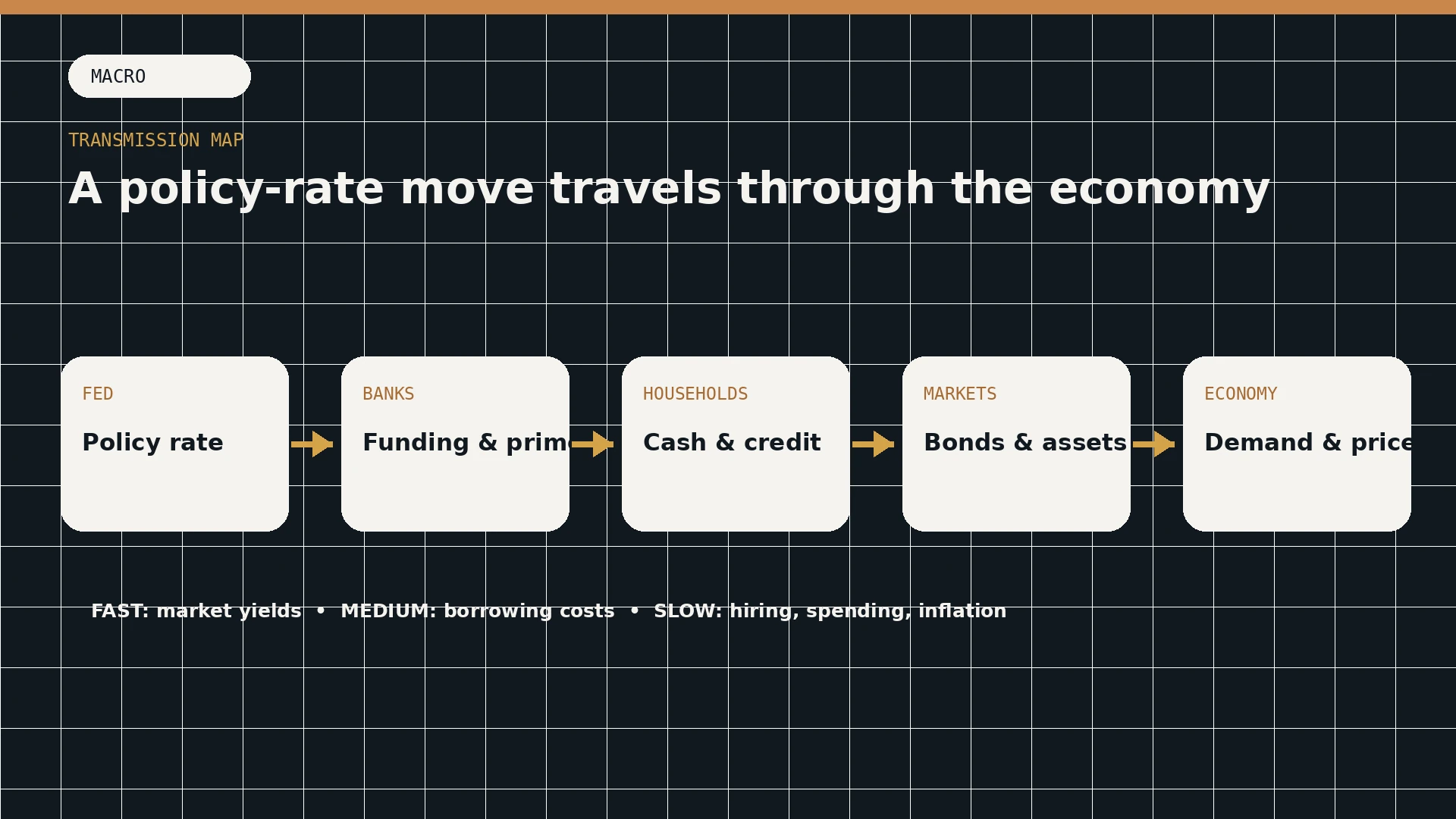
A Federal Reserve rate announcement is one input to a long chain. The Federal Open Market Committee sets a target range for the federal funds rate and uses its tools to influence overnight market rates. That change affects other rates, asset prices, credit conditions, spending, hiring, and inflation—but not all at once and not by the same amount.
A useful household response starts by identifying where you are in the chain.
Stage 1: policy and expectations
Financial markets continuously estimate the future path of policy, inflation, and growth. Treasury yields, mortgage rates, and asset prices may move before a meeting because investors expect a decision. After the announcement, markets respond not only to the current rate but to the statement, projections, press conference, and incoming data.
This is why “the Fed cut by 0.25 percentage point” does not imply that every rate will fall by exactly 0.25 point that day.
Stage 2: bank funding and short-term rates
Short-term market rates influence the cost and return of cash-like instruments. Banks and other providers decide how quickly and how fully to change deposit yields based on funding needs, competition, product terms, and customer behavior.
Review:
- Current annual percentage yield
- Whether the rate is variable or promotional
- Minimums and fees
- Deposit insurance coverage
- Transfer and withdrawal rules
- Alternatives with similar safety and liquidity
A policy change is a reason to recheck the account, not to move emergency cash into an unsuitable risk merely to preserve yield.
Stage 3: variable household debt
Credit cards and some lines of credit use variable rates tied to a benchmark plus a margin. The contract determines the timing and method of adjustment. A policy move can affect future interest, but balances, compounding, fees, payment amount, and promotional terms remain important.
Use the Credit Card Payoff Calculator or Loan Repayment Calculator with the actual current rate and a higher/lower scenario. Do not wait for a possible future cut when the current balance is already expensive and affordable repayment is available.
Stage 4: fixed-rate borrowing and housing
Existing fixed-rate loans normally keep their contracted rate. A lower market rate matters only if a new purchase, refinance, assumption, modification, or other transaction is available. Compare total cost, closing costs, break-even, term reset, and risk—not only the new payment.
Mortgage rates depend on longer-term yields, expected inflation, prepayment risk, mortgage-backed securities, lender capacity, borrower credit, and product structure. They can move differently from the overnight policy rate.
Where does the rate change touch your plan?
Compare yield, safety, liquidity, fees, and insurance; do not chase yield with emergency money.
Check the benchmark, margin, reset date, and payoff effect under several rate paths.
Nothing changes automatically; evaluate a refinance only on complete total cost.
Use the investment policy, horizon, and allocation instead of trading the announcement.
Stage 5: bonds and portfolios
Bond prices and yields move inversely, but the result depends on maturity, duration, credit risk, inflation expectations, and the starting yield. A rate decline can raise the price of existing fixed-rate bonds, while new cash flows may be reinvested at lower yields. A rate increase can reduce current prices while raising future reinvestment income.
Stocks are affected through discount rates, expected earnings, financing costs, and the economic outlook. A rate cut associated with falling inflation may be interpreted differently from a cut associated with severe economic weakness.
The practical response is to maintain the portfolio role:
- Cash for near-term obligations
- Bonds for income, stability, or known horizons
- Diversified growth assets for long-term goals
Stage 6: spending, hiring, and inflation
Monetary policy works with lags. Higher borrowing costs can reduce interest-sensitive spending and investment, but contracts reset at different times. Lower rates can support demand, yet the effect depends on confidence, credit access, fiscal policy, global conditions, and existing balance sheets.
Inflation does not mechanically return to target after a fixed number of months. Follow several releases and distinguish broad persistence from one volatile category.
Translate the headline into a household action
| Scenario | Best for | Upside | Main trade-off | Next step |
|---|---|---|---|---|
| Savings rate falls | Cash beyond immediate checking needs | Review can recover yield without changing the reserve’s job | Moving money can add delay or complexity | Compare insured accounts and Treasury options appropriate to the horizon |
| Card APR changes | Variable revolving debt | A lower rate may reduce interest modestly | The balance can still compound for years | Recalculate payoff and keep the payment rather than waiting |
| Mortgage quote moves | Purchase or refinance decision | Total financing cost may improve | Price, points, fees, and term can offset the rate | Compare loan estimates and break-even |
| Portfolio reacts sharply | Long-horizon investor | Rebalancing may restore planned risk | Trading the announcement can lock in a forecast | Use policy ranges and contribution rules |
A practical rate-decision checklist
Before acting, write the contract or account involved, whether its rate is fixed or variable, the reset method, the time horizon, and the dollar impact. A rate move that changes a $20,000 revolving balance is not the same decision as a small change in savings yield.
Then compare the rate effect with fees, taxes, liquidity, and the alternative use of cash. The policy headline is context; the household contract is the decision.
Turn the page into action
Respond to a rate change without guessing
- Identify whether the relevant rate is fixed, variable, or only a market quote.
- Read the benchmark, margin, reset date, fees, and term.
- Model a higher, current, and lower rate scenario.
- Compare total dollars, not only the percentage change.
- Keep emergency liquidity and the investment policy intact.
- Review again only when the contract, goal, or economic evidence materially changes.
Evidence to action
Methods and evidence
Methods used
- Real return
real return = (1 + nominal return) ÷ (1 + inflation rate) − 1
Related data series
- Federal Reserve policy rateCataloged; automatic updating is not active yet.
Next actions
Structured datasources.jsonformulas.jsonsystems.json
Evidence
Sources
- Economy at a Glance — Policy Rate
federal-reserve-policy-rateBoard of Governors of the Federal Reserve SystemAccessedAugust 18, 2026
- Monetary Policy and the Economic Outlook
federal-reserve-monetary-policy-outlook-2023Board of Governors of the Federal Reserve SystemAccessedAugust 18, 2026
- Beginner's Guide to Asset Allocation, Diversification, and Rebalancing
sec-beginners-asset-allocationU.S. Securities and Exchange Commission — Investor.govAccessedAugust 18, 2026
Common questions
Frequently asked questions
Does a Federal Reserve rate cut immediately lower my mortgage rate?
Not necessarily. Mortgage rates are influenced by longer-term Treasury yields, inflation expectations, market demand, credit conditions, and lender pricing. Existing fixed-rate loans do not change unless refinanced or modified.
What usually changes fastest after a policy-rate decision?
Market interest rates and expectations can move before or immediately after a decision. Deposit pricing, credit-card rates, business borrowing, spending, hiring, and inflation may respond on different schedules.
Should I change investments after every rate announcement?
A rate decision should be interpreted through the investment policy and time horizon. Markets may already reflect expectations, and the same rate move can affect assets differently for reasons beyond the announcement.