When the first reserve tier is not yet funded and the current month is already short, switch to the 30-day cash-flow triage guide to rank obligations by consequence.
“Save three to six months” is easy to repeat and hard to implement. It treats the emergency fund as one large target even though the first $500 and the final month of runway solve very different problems. A better method is to build the reserve in layers, with a specific job, access rule, and completion test for each layer.
The purpose is not to maximize the account balance. It is to reduce the chance that a manageable disruption turns into expensive debt, missed work, lapsed coverage, or a forced decision.
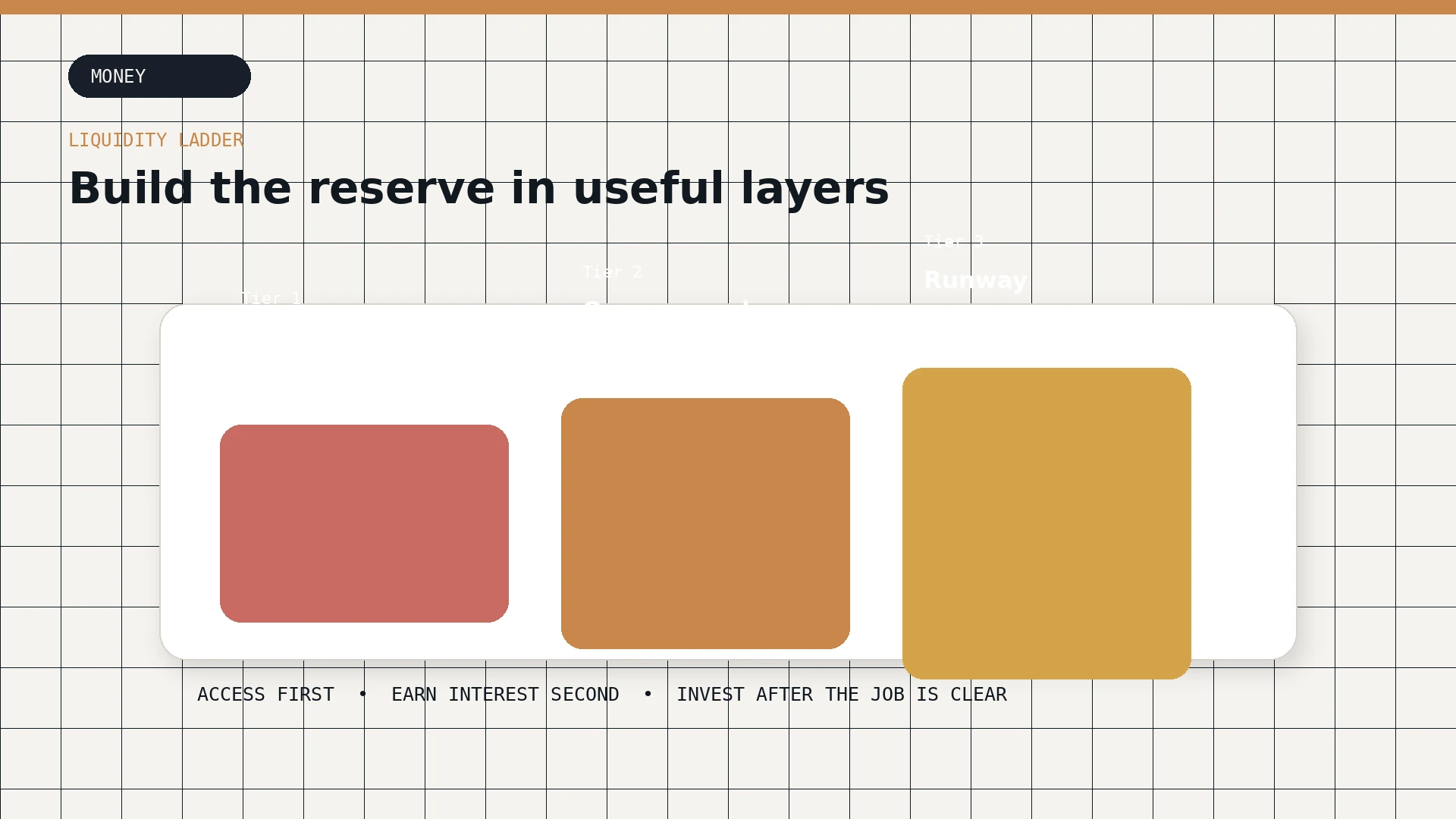
Tier 1: stop small shocks from becoming debt
The first tier should cover the kind of expense that regularly destabilizes the household: an urgent repair, medical copay, insurance deductible, necessary trip, or gap before payday. For many households, the right number is not a round rule of thumb. It is the largest common shock that would otherwise go on a credit card.
Review the last year of irregular expenses. Identify the three events most likely to recur and choose a first target that can absorb at least one without borrowing. If $1,000 feels unreachable, start with a smaller milestone and automate the next one. A reserve that exists is more useful than a perfect target that never gets funded.
Tier 2: protect one full pay cycle
After Tier 1, build enough to cover required spending from one normal income date to the next. This is the buffer that prevents timing problems, payroll errors, delayed client payments, and annual bills from turning into emergencies.
Calculate required spending, not total lifestyle spending. Include housing, basic utilities, food, medicine, insurance, transport, childcare, and contractual minimums. Exclude spending that could be paused immediately without serious consequence.
Tier 2 is especially valuable for people paid monthly, freelancers, commission workers, and households whose largest bills occur before the main paycheck.
Tier 3: create transition runway
The third tier protects against a longer interruption: job loss, illness, caregiving, relocation, business slowdown, or a necessary exit from unsafe or unsustainable work. The target should reflect the household’s actual recovery time, not a universal month count.
Longer runway is more valuable when:
- One income supports most required spending.
- The occupation has long hiring cycles.
- Income is seasonal or commission-based.
- Insurance deductibles or medical exposure are high.
- The household may need to relocate.
- Dependents rely on the same income.
- The household has limited family or public support.
Shorter runway may be reasonable when two independent incomes cover required spending, demand for the work is strong, benefits are stable, and major deductibles are already funded separately.
Which reserve tier should receive the next dollar?
Finish Tier 1 before extra investing or aggressive debt payments.
Build Tier 2 to one complete pay cycle of required spending.
Build Tier 3 using realistic replacement time and required spending.
Assign excess cash to debt, investing, a sinking fund, or another explicit goal.
Keep emergency savings separate from predictable costs
A predictable cost is not an emergency simply because it is infrequent. Annual insurance, vehicle registration, holiday travel, school expenses, routine maintenance, and known tax payments should use sinking funds. Mixing them with the emergency fund makes the reserve look larger than it really is and creates repeated “emergencies” on the same date every year.
Use separate categories even when the money is held in one insured bank account. The distinction is about ownership of the balance: the annual premium is already spoken for; the emergency tier is not.
Choose access before yield
The reserve should be safe, liquid, and understandable. Compare:
- Deposit insurance coverage
- Transfer time
- Withdrawal limits or fees
- Minimum balance requirements
- Whether access depends on a specific device or linked bank
- Fraud and account-freeze procedures
- Interest rate and rate-change policy
The first tier needs the fastest access. A later runway tier may tolerate a short transfer delay, but it should not depend on selling a volatile asset during a market decline. Stocks, long-duration bonds, retirement accounts with restrictions, and speculative assets can support long-term wealth; they are poor substitutes for money needed on a specific bad day.
Coordinate the reserve with debt
The emergency fund and debt plan should not fight each other. A household that sends every spare dollar to debt and then re-borrows for each repair is not making durable progress. A household that keeps a very large cash balance while paying extremely expensive debt may also be wasting capacity.
Balance liquidity and debt deliberately
| Scenario | Best for | Upside | Main trade-off | Next step |
|---|---|---|---|---|
| High-cost revolving debt | Credit-card balances with weak cash reserves | A small buffer stops repeated re-borrowing | Holding too much cash prolongs expensive interest | Fund Tier 1, pay minimums, then attack one balance |
| Stable low-rate debt | Affordable fixed payments and stable income | More reserve can protect a major transition | Cash may earn less than the debt rate | Build the tier that matches job and household risk |
| Variable income | Freelance, commission, seasonal work | A larger buffer smooths low months | Requires discipline during high months | Base spending on conservative income and sweep excess to the reserve |
| Near-term major change | Relocation, leave, career switch | Cash preserves choice and reduces forced borrowing | May delay investing or payoff goals | Add transition costs to Tier 3 |
Define what counts as an emergency before one happens
Write a short withdrawal rule. A valid emergency normally has three features: it is necessary, difficult to postpone, and not already funded elsewhere. Examples include essential repairs, urgent health costs, income interruption, emergency travel, and expenses needed to keep working.
A sale, market dip, vacation upgrade, or ordinary annual bill does not become an emergency because the cash is available.
Refill with a fixed sequence
When the reserve is used:
- Record the reason and amount.
- Confirm whether it was truly unexpected or a missing sinking fund.
- Restore Tier 1 first.
- Resume the prior debt or investing plan only after the chosen refill point.
- Adjust the target if the event revealed a larger real risk.
Turn the page into action
Set your emergency-fund target
- List the three most likely irregular shocks and choose a Tier 1 amount.
- Calculate one pay cycle of required spending for Tier 2.
- Estimate realistic income-replacement or transition time for Tier 3.
- Separate annual and predictable costs into sinking funds.
- Choose accounts based on safety, access, fees, and insurance before yield.
- Write a withdrawal and refill rule before the reserve is needed.
Evidence to action
Methods and evidence
Methods used
- Emergency runway
runway months = liquid reserves ÷ essential monthly outflow
Related data series
- Economic Well-Being of U.S. HouseholdsCataloged; automatic updating is not active yet.
Next actions
Structured datasources.jsonformulas.jsonsystems.json
Evidence
Sources
- Saving for the Unexpected and Your Future
fdic-saving-unexpectedFederal Deposit Insurance CorporationAccessedAugust 18, 2026
- Your Money, Your Goals toolkit
cfpb-your-money-your-goalsConsumer Financial Protection BureauAccessedAugust 18, 2026
- Economic Well-Being of U.S. Households in 2025 — Executive Summary
federal-reserve-household-wellbeing-2025Board of Governors of the Federal Reserve SystemAccessedAugust 18, 2026
Common questions
Frequently asked questions
How much should I save before paying extra debt?
Start with enough cash to prevent a common small shock from returning to the card or loan you are paying down. After that first tier, compare the debt cost, job stability, insurance deductibles, and access to other cash before choosing between more reserve and faster repayment.
Where should an emergency fund be kept?
Keep the portion needed quickly in a safe, liquid account that can be accessed without market risk or a long delay. A higher yield is useful only when access, fees, insurance coverage, and withdrawal rules still fit the reserve’s job.
Does a credit card count as an emergency fund?
A card is borrowing capacity, not owned liquidity. It can help with payment mechanics, but approval, limits, interest, fraud holds, and issuer decisions can change when the household is under stress.