If the runway supports several plausible paths, use the reversible versus irreversible decisions guide to test the uncertain choice before accepting long-term lock-in.
Emergency savings answer, “Can the household absorb a shock?” Optionality runway asks a broader question: How long can the household choose among several paths without being forced into the first available outcome?
That matters before leaving a job, relocating, starting a business, reducing work for caregiving, or making another decision that changes income and fixed costs.
The baseline formula
A simple runway estimate is:
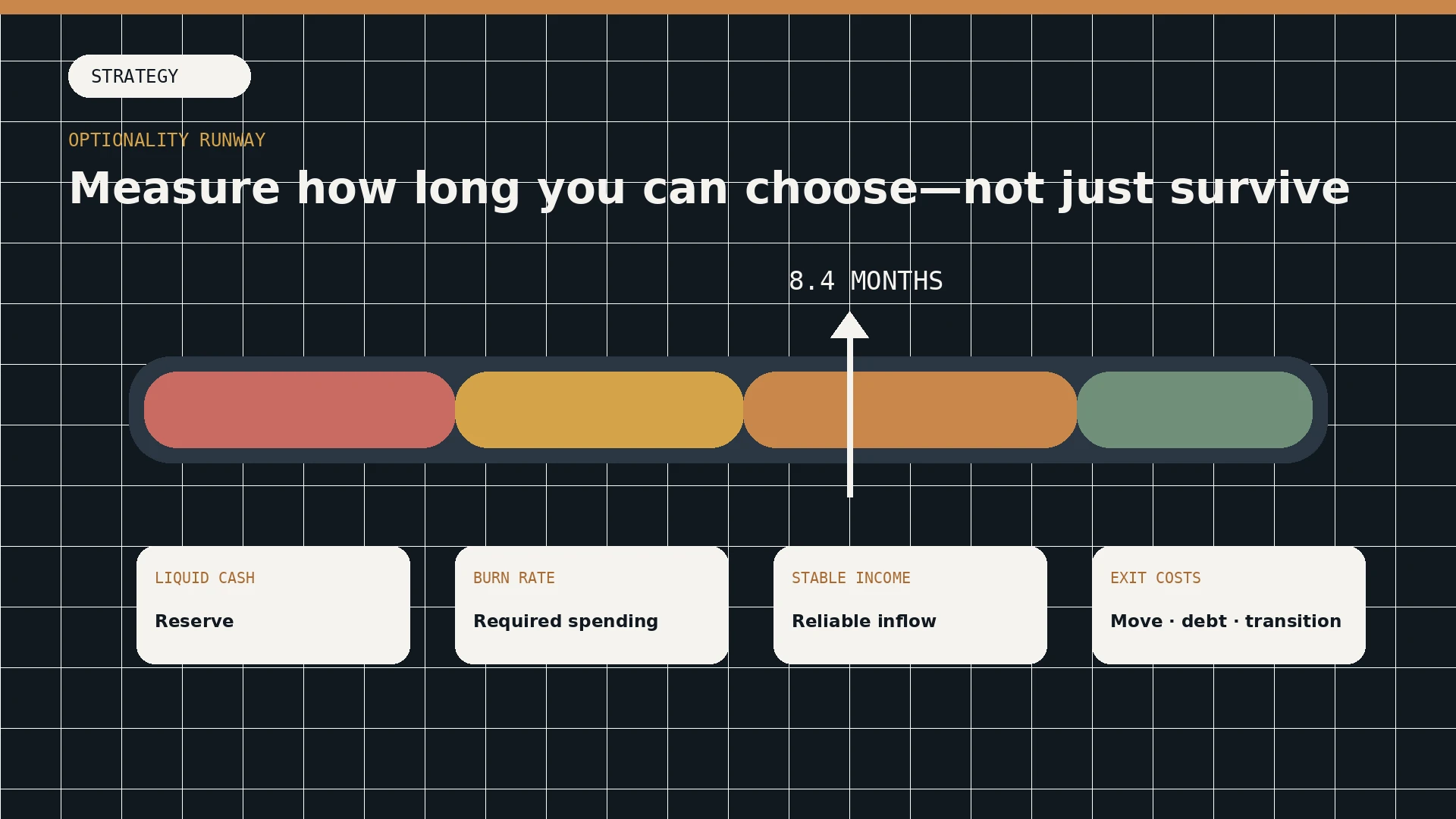
(Liquid resources − one-time transition costs) ÷ monthly net burn
Monthly net burn is required monthly spending minus reliable after-tax monthly income expected to continue during the transition.
Example:
- Liquid resources: $30,000
- Transition costs: $6,000
- Required monthly spending: $5,000
- Reliable continuing income: $2,000
- Net burn: $3,000
- Baseline runway: 8 months
The number is a planning estimate, not a guarantee. Its value comes from making assumptions visible.
Define liquid resources conservatively
Include cash and accounts that can be accessed in the required time without unacceptable loss. Apply haircuts to assets with taxes, penalties, volatility, settlement delays, or uncertain resale.
Do not count available credit as owned resources. A line can be reduced or become more expensive when income changes. It can be listed as contingency borrowing, but not as baseline runway.
Calculate required spending
Use the Budget Planner to separate required spending from lifestyle spending. Required spending normally includes housing, essential utilities, food, medicine, insurance, transport, childcare, taxes, and contractual minimums.
Create three burn rates:
- Normal — current required spending
- Reduced — costs that can realistically be cut within one month
- Stress — includes a major deductible, repair, temporary housing, or another adverse event
Do not assume that every optional expense disappears immediately. Contracts, family obligations, and transition costs create delay.
Classify income by reliability
Stable income
Income expected to continue under the scenario: a partner’s salary, pension, benefit, long contract, or diversified recurring revenue. Use after-tax cash that is available to the household.
Variable income
Freelance, commission, tips, seasonal work, business distributions, and creator income. Apply a haircut based on volatility and whether the scenario could reduce demand.
Concentrated income
Income dependent on one client, employer, platform, property, or product. Even if stable historically, it creates correlated risk. A job transition may reduce referrals; an economic slowdown may affect both employment and freelance work.
Which income belongs in the runway calculation?
Include conservative after-tax cash expected to continue.
Include a haircut based on the weakest recent cycle.
Use a severe haircut or exclude it from the stress case.
Treat it as upside, not baseline runway.
Add one-time transition costs
Common omissions include:
- Moving and deposits
- Health-insurance transition
- Visa, licensing, or legal costs
- Equipment and setup
- Business formation and initial marketing
- Debt payoff required before a change
- Tax payments on prior income
- Training and certification
- Temporary double housing
- Travel and storage
Subtract these before dividing by monthly burn. A household with 12 months of expenses and a large relocation cost may have much less decision runway.
Calculate three cases
Runway should be a range
| Scenario | Best for | Upside | Main trade-off | Next step |
|---|---|---|---|---|
| Base case | Planning with conservative expected income and spending | Creates the working decision number | Still depends on assumptions | Update monthly while the transition is active |
| Stress case | Income interruption plus one major cost | Shows whether the plan survives bad timing | Can feel overly cautious | Define the trigger that activates deeper cuts |
| Recovery case | Income returns gradually | Shows the value of partial work | Recovery timing is uncertain | Set milestone income rather than one perfect job date |
| Exit case | The original plan fails | Prevents runway from reaching zero | Requires an early change of direction | Set the minimum months remaining that trigger the exit |
Set runway thresholds
The household should decide in advance what happens at specific remaining months. Example:
- 9 months: continue the planned search or pilot
- 6 months: expand work options and reduce discretionary commitments
- 4 months: activate the backup location, role, or business model
- 2 months: preserve housing and essentials; stop optional investment in the transition
Thresholds turn runway into an operating system. Without them, people often wait until the reserve is nearly gone before changing course.
Improve runway by changing the denominator
Runway is not only about saving more. It can improve by:
- Lowering required fixed costs
- Replacing one large obligation with a flexible one
- Adding a reliable part-time income floor
- Diversifying clients
- Negotiating remote or transitional work
- Delaying an irreversible expense
- Funding health, tax, or moving costs separately
A small reliable income stream can extend runway more than the same amount of uncertain future revenue.
Keep long-term goals visible
Using retirement or investment assets may extend near-term runway while weakening long-term independence. Show the trade explicitly. Create a “protected assets” line that is excluded unless the stress case reaches a stated trigger.
Turn the page into action
Calculate your optionality runway
- List liquid resources and apply access, tax, and market haircuts.
- Subtract all one-time transition and contingency costs.
- Calculate normal, reduced, and stress required spending.
- Include only conservative after-tax income expected to continue.
- Run base, stress, recovery, and exit cases.
- Set remaining-month thresholds that trigger specific actions.
Make the runway usable during an interruption: create a financial emergency binder that identifies essential bills, contacts, and document locations without putting credentials in an ordinary shared file.
Evidence to action
Methods and evidence
Methods used
- Emergency runway
runway months = liquid reserves ÷ essential monthly outflow
Related data series
- Economic Well-Being of U.S. HouseholdsCataloged; automatic updating is not active yet.
Next actions
Structured datasources.jsonformulas.jsonsystems.json
Evidence
Sources
- Economic Well-Being of U.S. Households in 2025 — Executive Summary
federal-reserve-household-wellbeing-2025Board of Governors of the Federal Reserve SystemAccessedAugust 18, 2026
- Saving for the Unexpected and Your Future
fdic-saving-unexpectedFederal Deposit Insurance CorporationAccessedAugust 18, 2026
- Your Money, Your Goals toolkit
cfpb-your-money-your-goalsConsumer Financial Protection BureauAccessedAugust 18, 2026
Common questions
Frequently asked questions
How is optionality runway different from an emergency fund?
An emergency fund is a reserve target. Optionality runway estimates how long liquid resources and reliable income can support required spending after a specific transition cost or stress scenario.
Should retirement accounts count as runway?
Only with a deliberate haircut that reflects taxes, penalties, market risk, access rules, and the fact that using the account may damage another goal. Near-term runway should emphasize truly accessible liquidity.
Why adjust variable income?
A transition or recession may reduce the same variable income the plan expects to continue. Applying a conservative haircut prevents optimistic revenue from overstating the time available.