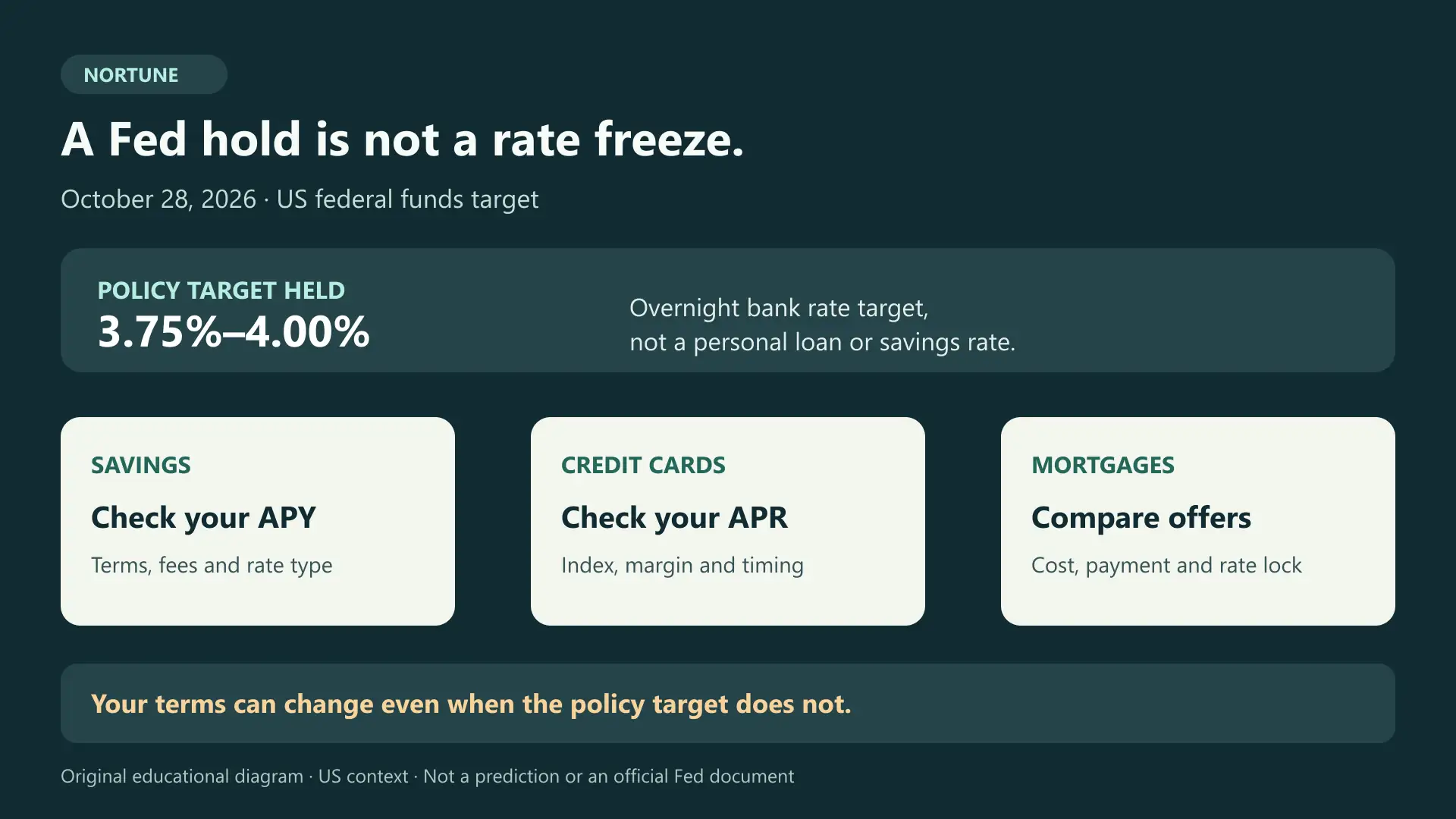
The Federal Reserve kept its target range for the federal funds rate at 3.75%–4.00% on October 28, 2026. The decision leaves the policy range where it stood after September’s increase. It does not promise that a savings account’s yield, a credit card’s annual percentage rate (APR), or a new mortgage offer will stay where it is. Those prices depend on their own terms and market conditions.
What the October decision says
In its October 28 statement, the Federal Open Market Committee voted 10–2 to maintain the range. Lisa D. Cook and Beth M. Hammack dissented, preferring a quarter-percentage-point increase. The committee described inflation as elevated and said it would consider additional information when determining the appropriate policy stance; the announcement does not promise a particular next move.
The distinction from September matters: on September 16, the committee raised the range by 0.25 percentage point to its current level. October’s decision was a hold, not another increase. The two announcements describe a US monetary-policy target, not a rate set individually for each household.
The policy target is not your account rate
The federal funds rate concerns overnight borrowing between banks. Monetary policy can influence other short-term rates and the economy, but the Fed does not set a person’s credit-card APR, bank savings APY or mortgage quote at 3.75%–4.00%. Timing and the connection to the policy rate differ by product.
For a broader explanation, use Nortune’s Federal Reserve rate-change guide. For a household budget, start with the actual document and rate that apply to your account today, then identify when and how they can change.
Credit cards: find the index and the margin
A variable card APR changes with a specified index, often a prime rate, according to the card agreement. A hold in the Fed’s target range does not by itself rewrite that agreement or tell you exactly when your issuer recalculates the rate. Check the statement for the APR on each balance, the agreement for the index and margin, and the end date of any promotional rate.
Fixed APR means the rate does not fluctuate with an index; it does not necessarily mean it can never change. Different rules and notice requirements may apply. If you carry a balance, the APR and the balance subject to it matter more for your next budget than assuming the policy announcement is your personal rate.
Mortgages: compare offers and existing loan terms
The Fed’s hold does not lock a new mortgage quote. The Consumer Financial Protection Bureau notes that interest rates can change daily. Compare Loan Estimates for the same loan amount and type, as close in time as practical. Examine the interest rate, APR, lender charges, points or credits, cash to close, and total monthly payment. Ask whether the rate is locked, when the lock ends and what an extension costs.
An existing fixed-rate mortgage has a fixed interest rate under its terms; taxes and insurance in the total payment can still change. An adjustable-rate mortgage can reset according to its index, margin, adjustment schedule and caps. A policy hold does not cancel an approaching contractual adjustment.
Savings: the current APY is a starting point
A variable deposit rate or annual percentage yield (APY) can change under the account’s disclosed terms. The CFPB’s sample account disclosures illustrate rates determined by an index or the institution’s discretion, and different change frequencies. They are examples of disclosures, not a promise that any particular bank will move its rate.
Review the current APY, whether it is variable or promotional, balance requirements, fees and any restrictions before using it in a cash plan. A certificate of deposit may have different fixed-rate and early-withdrawal terms; check the specific account documents.
A five-minute review for your next budget
Use the latest statement or written offer. The table is a planning aid, not a forecast or a recommendation to borrow, switch accounts or invest. Do not put account numbers, login credentials or other private details in a shared note.
| Product | Check now | Note for your budget |
|---|---|---|
| Credit card | Balance APR, index, margin and promotion end date | Record the rate and when its terms say it can change. |
| Mortgage | Loan type, comparable costs, lock expiry or adjustment date | Use the written offer or current loan terms, including taxes and insurance. |
| Savings | Current APY, variable or fixed term, balance rules and fees | Review what is actually credited and when a promotion or term ends. |
These examples describe US financial products and disclosures. Puerto Rico residents should confirm the terms and applicable rules for their own institution, and readers in Japan should not assume US rules apply to a Japanese account. The next Fed meeting and any future account changes remain uncertain; review the relevant documents when your circumstances change. Sources were checked during preparation with automated assistance. No independent financial professional review or product testing was performed.
Evidence
Sources
- Federal Reserve issues FOMC statement, October 28, 2026
fed-fomc-october-28-2026Federal ReservePublishedOctober 28, 2026AccessedOctober 29, 2026
- Federal Reserve issues FOMC statement, September 16, 2026
fed-fomc-september-16-2026Federal ReservePublishedSeptember 16, 2026AccessedOctober 29, 2026
- The Federal Reserve policy rate
federal-reserve-policy-rateFederal ReserveAccessedOctober 29, 2026
- Fixed APR and variable APR
cfpb-credit-card-variable-aprConsumer Financial Protection BureauAccessedOctober 29, 2026
- Compare Loan Estimates
cfpb-compare-loan-estimatesConsumer Financial Protection BureauAccessedOctober 29, 2026
- Regulation DD: Model Clauses and Sample Forms
cfpb-deposit-model-clausesConsumer Financial Protection BureauAccessedOctober 29, 2026
- Fixed-rate and adjustable-rate mortgages
cfpb-fixed-vs-adjustable-mortgageConsumer Financial Protection BureauAccessedOctober 29, 2026
Common questions
Frequently asked questions
Does the Fed hold fix my savings rate?
No. A variable savings rate or APY can change under your account terms. Check the current disclosure, fees and any promotional or fixed term.
Does a hold stop a credit card APR from changing?
No. A variable APR follows the index and margin in the agreement, and promotional periods can end. Even a fixed APR may change in some circumstances.
Does a Fed hold lock my mortgage offer?
No. A lender quote can change; ask whether the rate is locked, the lock expiration and any extension costs. Compare the written estimates and other loan costs.