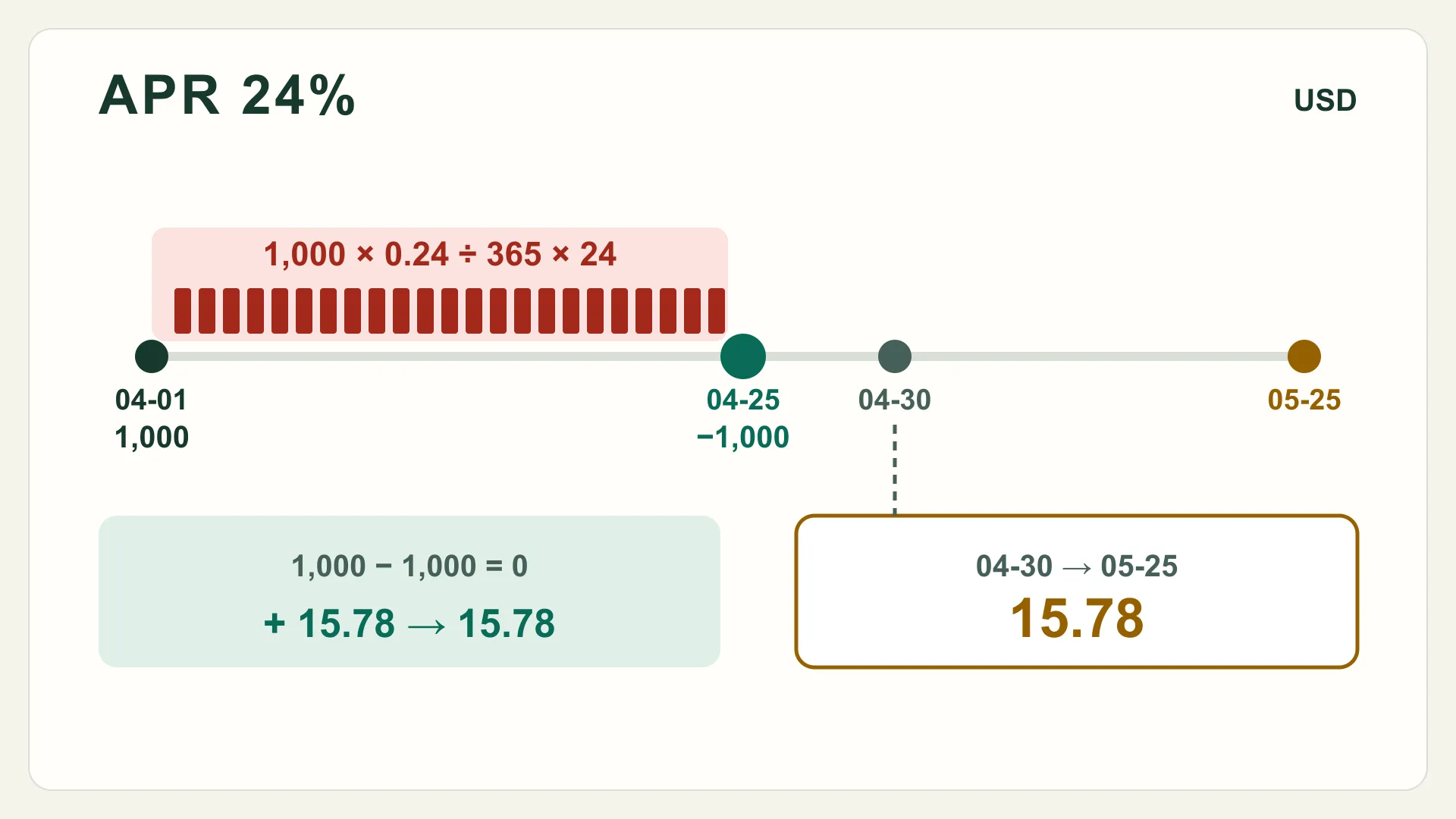
You paid the full statement balance, yet the next statement shows an interest charge. On a U.S. credit card this is usually trailing interest, also called residual interest. It is not a second charge on money you already repaid. It is interest that kept accruing day by day between the statement closing date and the day your payment arrived.
This guide explains when it happens, how to estimate it, what the federal Truth in Lending rule (12 CFR part 1026) does and doesn't prohibit, and how to stop it. The figures are hypothetical, in U.S. dollars, and simplified. Your card agreement and statements govern the actual calculation. This is general education, not individual credit or legal advice.
Grace periods decide whether interest starts at all
The Truth in Lending rule defines a grace period as a period within which credit extended may be repaid without incurring a finance charge due to a periodic interest rate (12 CFR 1026.5). For credit cards, the issuer must have reasonable procedures to mail or deliver the periodic statement at least 21 days before the payment due date.
A grace period is not guaranteed. The official interpretations state that the rule limiting interest after a lost grace period does not require the issuer to provide one. Issuers may also attach conditions, such as paying the previous statement balance in full by the due date. The account-opening disclosures in 12 CFR 1026.6 must describe the grace period and its conditions, or state that there is none. In the summary table, this appears under the heading “How to Avoid Paying Interest.” Read that row first.
The official interpretations use a typical two-condition example: if you paid last month's statement balance in full by its due date, new purchases are interest-free until the next due date. If you carried a balance, there is no grace period on that balance, and often none on new purchases either, until you pay a statement in full again.
Where trailing interest comes from
When there is no grace period, interest accrues daily on the balance. The statement shows the balance as of the closing date, but interest keeps accruing after that date until your payment posts. Those days of interest don't appear on the statement you just paid. They appear on the next one.
The official interpretations describe the same pattern in a worked example: a balance not eligible for a grace period, paid on the due date, followed by a statement reflecting “trailing or residual interest” that accrued on that balance from the start of the cycle until the payment.
Estimate it with the daily rate
Suppose billing cycles run with the calendar month and payments are due on the 25th. The purchase APR is 24%, so the simplified daily periodic rate is 24% ÷ 365 ≈ 0.0658%. You did not pay the February statement in full, so on March 31 the account carries a $1,000 balance with no grace period. You make no new purchases and pay the full $1,000 statement balance on April 25.
| Item | Value |
|---|---|
| Balance carried into April | 1,000.00 |
| Daily periodic rate | 0.24 ÷ 365 |
| Days with the balance outstanding (April 1–24) | 24 |
| Trailing interest on the April statement | 1,000 × 0.24 ÷ 365 × 24 = 15.78 |
| April statement balance, due May 25 | 15.78 |
The formula is:
Trailing interest ≈ balance × (APR ÷ 365) × days from the start of the cycle (or last payment) until the payment posts.
Issuers commonly use an average daily balance and may compound daily or use a 360-day year. The real charge can therefore differ slightly from this estimate. A large difference is worth asking about. The APR vs. APY guide explains why a stated APR and the effective cost of compounding differ.
New purchases made while you have no grace period may also accrue interest from the purchase date. Whether they do depends on your card's terms, which is why that “How to Avoid Paying Interest” row matters.
What federal rules prohibit after a lost grace period
If you had a grace period and then lost it, for example by paying only part of a statement, 12 CFR 1026.54 limits the interest the issuer can impose because of that loss. It cannot base interest on balances for days in billing cycles before the most recent one. It also cannot base interest on any portion of the balance that you repaid before the grace period expired. This ended the old practice of reaching back into earlier cycles, sometimes called double-cycle billing.
| Possible interest charge | Treatment under 12 CFR 1026.54 |
|---|---|
| Interest on the June balance for days in June | Prohibited: days in a billing cycle before the most recent one |
| Interest on the $1,500 repaid by July 25 | Prohibited: portion repaid before the grace period expired |
| Interest on the unpaid $500 for days in the July cycle | Not limited by this section; follows the card's terms |
The rule has two exceptions: adjustments after a billing dispute is resolved, and adjustments after a payment is returned. It also does not cover deferred-interest promotions, where accrued interest can be charged if the promotional balance is not paid in full in time. Those follow separate rules, so treat a deferred-interest offer differently from a balance transfer at a promotional rate.
How to stop trailing interest
- Pay the trailing amount. In the example, paying the April statement balance of $15.78 by May 25 clears it. Under terms like the official two-condition example, paying that statement in full by its due date also makes later purchases eligible for the grace period again.
- Or ask for a payoff amount. If you want to close out the balance in one payment, ask the issuer for the amount needed to pay in full on a specific date, including interest accrued through that date.
- Pause card spending until the grace period returns if your terms charge interest on new purchases while a balance is carried.
- Keep paying the full statement balance by each due date. That is the usual condition for keeping the grace period.
If you can't pay statements in full, trailing interest is a symptom of a carried balance. The minimum-payment guide shows how to measure principal progress, and the debt repayment order helps you choose which balance to attack first.
Turn the page into action
Check an unexpected interest charge
- Find the “How to Avoid Paying Interest” row in your card agreement or pricing table.
- Note whether the previous statement balance was paid in full by its due date.
- List the closing date, payment date and daily periodic rate from the statement.
- Estimate daily interest on the balance for the days before your payment arrived.
- Compare the estimate with the statement's interest charge; small differences can come from the issuer's balance method.
- If a lost grace period is involved, confirm no interest was charged on amounts repaid in time.
- Ask the issuer for a payoff amount through a specific date if you want to end trailing interest now.
- Keep the statements and the issuer's explanation.
Boundaries
This guide covers U.S. consumer credit-card accounts under 12 CFR part 1026 (the Truth in Lending rule) as published in the electronic Code of Federal Regulations. It does not cover business cards, home-secured lines, charge cards with different terms, or non-U.S. cards, including Japanese revolving payments. Card agreements, balance methods and promotional terms vary. All figures are hypothetical, and no issuer's real terms are shown. If a charge seems inconsistent with your agreement, ask the issuer in writing for the calculation and keep your statements.
Evidence to action
Methods and evidence
Methods used
- Trailing credit-card interest estimate
I ≈ B × (APR ÷ 365) × d, where d = days from cycle start (or last payment) until the payment posts; issuer balance and compounding methods can differ
Next actions
Structured datasources.jsonformulas.jsonsystems.json
Evidence
Sources
- 12 CFR 1026.54: Limitations on the imposition of finance charges
ecfr-reg-z-1026-54Electronic Code of Federal Regulations (Consumer Financial Protection Bureau rule)AccessedOctober 24, 2026
- 12 CFR 1026.5: General disclosure requirements (statement timing and grace period)
ecfr-reg-z-1026-5Electronic Code of Federal Regulations (Consumer Financial Protection Bureau rule)AccessedOctober 24, 2026
- 12 CFR 1026.6: Account-opening disclosures
ecfr-reg-z-1026-6Electronic Code of Federal Regulations (Consumer Financial Protection Bureau rule)AccessedOctober 24, 2026
- Supplement I to Part 1026: Official interpretations
ecfr-reg-z-supplement-iElectronic Code of Federal Regulations (Consumer Financial Protection Bureau rule)AccessedOctober 24, 2026
Common questions
Frequently asked questions
Why was I charged interest after paying my balance in full?
If you were carrying a balance, there was usually no grace period. Interest kept accruing daily between the statement closing date and the day your payment arrived, and that trailing (residual) interest appears on the next statement.
Does a credit card have to offer a grace period?
No. The official interpretations of 12 CFR part 1026 say the rule limiting interest after a lost grace period does not require a grace period at all. The card agreement must disclose whether there is one, under the heading “How to Avoid Paying Interest.”
Can the issuer charge interest on the part I already paid?
If you had a grace period and then lost it, 12 CFR 1026.54 bars interest on any portion repaid before the grace period expired and on balances for days in earlier billing cycles. Disputes and returned payments are exceptions.
How do I stop trailing interest?
Ask the issuer for a payoff amount that includes interest accrued through the payment date, or pay the next statement in full, including the trailing amount. Following the card's grace-period conditions after that usually stops new purchase interest.