Tax-loss harvesting means selling an investment in a taxable U.S. brokerage account for less than its adjusted basis so the realized capital loss can offset other results on your federal return. The loss does not change what the portfolio is worth; it changes which year, and which line of Schedule D, a tax result lands in.
This guide works through a dated, hypothetical U.S.-dollar example for tax year 2026. It is a general federal framework, not tax advice. Retirement accounts, state taxes, Puerto Rico residence and non-U.S. systems follow their own rules.
What a harvested loss actually does
A realized loss is not free money. Under IRS Publication 550, it moves through a fixed order:
- It offsets capital gains of the same character: short-term against short-term, long-term against long-term.
- Any remaining net loss in one character offsets a net gain in the other.
- A total net loss reduces other income by the lesser of $3,000 ($1,500 if married filing separately) or the total net loss.
- Whatever is left carries over to later years until it is used up.
If you buy a replacement investment, its basis is the new, lower purchase price. A later sale at a higher price produces a larger gain than the original position would have, so harvesting often defers tax rather than eliminating it. The value comes from timing, from rate differences between years or between short- and long-term gains, and from the annual deduction against ordinary income.
Step 1: list realized results and candidate losses by character
Download your broker's year-to-date realized gain and loss report and its unrealized lot detail. Holdings kept one year or less are short-term; holdings kept more than one year are long-term. Record, for each candidate lot, the trade date bought, quantity, adjusted basis, current value and unrealized gain or loss.
Work at lot level. If the same fund was bought several times, the lots can have very different bases and holding periods. The tax-lot methods guide explains how specific identification lets you choose the high-basis lots and what records the broker needs at the time of the sale.
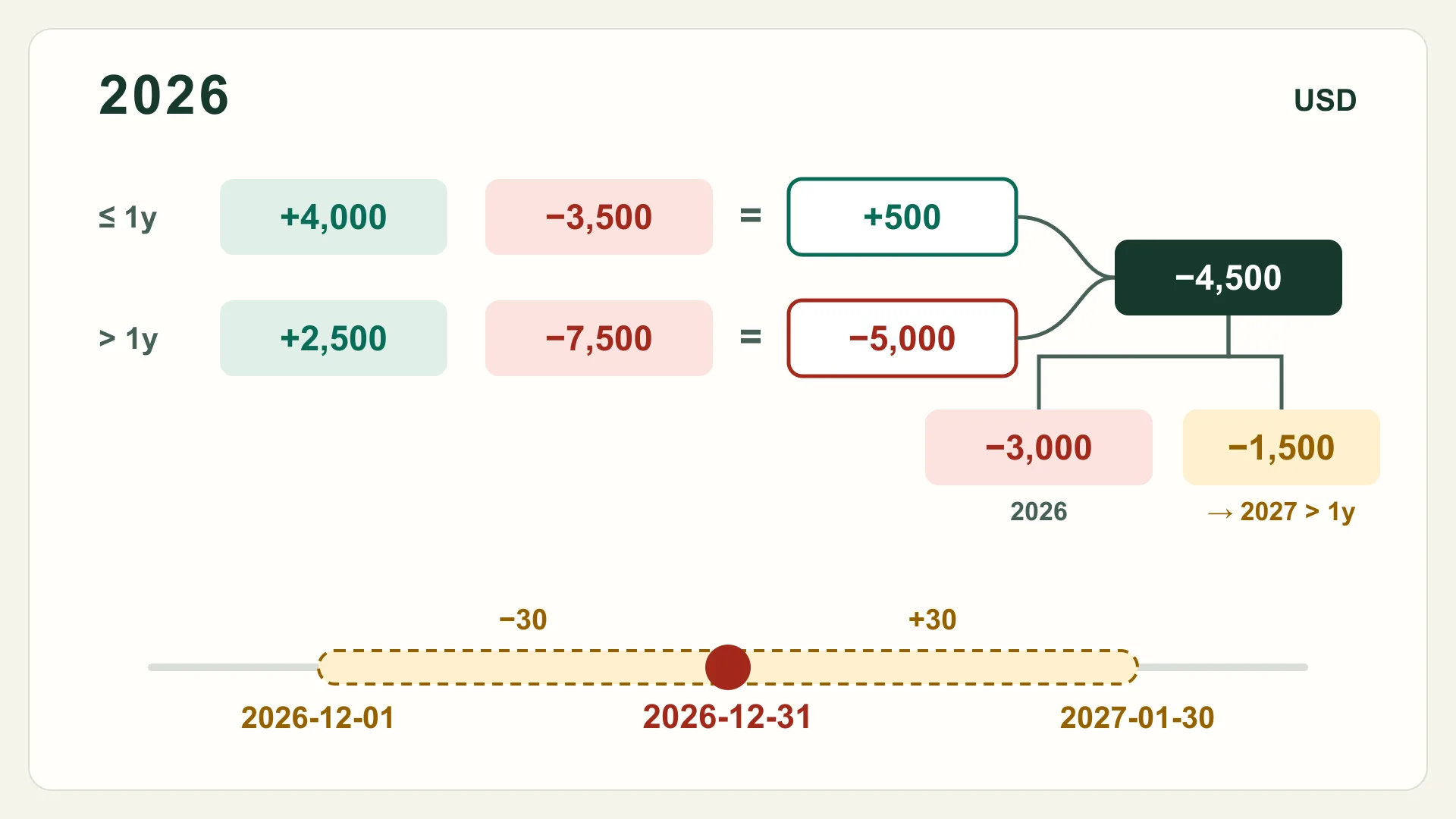
In the hypothetical example, the household has already realized a $4,000 short-term gain and a $2,500 long-term gain in 2026. Two lots show unrealized losses: Lot A, held five months, is down $3,500 (short-term); Lot B, held three years, is down $7,500 (long-term).
Step 2: net the results in IRS order before choosing
Run the arithmetic for each choice before trading. The totals below follow Schedule D's structure: net short-term (line 7), net long-term (line 15) and total (line 16).
| Choice | Net short-term | Net long-term | Total net | Deducted against other income | Carryover to 2027 |
|---|---|---|---|---|---|
| No harvesting | +4,000 | +2,500 | +6,500 gain | 0 | 0 |
| Harvest Lot A only | +500 | +2,500 | +3,000 gain | 0 | 0 |
| Harvest Lots A and B | +500 | −5,000 | −4,500 loss | 3,000 | 1,500 long-term |
Harvesting both lots realizes $11,000 of losses. They are used as follows: $6,500 cancels this year's gains, $3,000 reduces other income, and $1,500 carries forward. The total is $6,500 + $3,000 + $1,500 = $11,000, so nothing is lost or double-counted.
Notice what the netting order does. Lot A's short-term loss offsets gains that would otherwise be taxed at ordinary rates. Lot B's long-term loss first absorbs the long-term gain, then crosses over. Your actual value depends on your own marginal rates, which this guide does not estimate.
Step 3: size the carryover by character
The carryover keeps its short-term or long-term character, and IRS instructions use short-term losses first when absorbing the current year's deduction. The Capital Loss Carryover Worksheet in Publication 550 and the Schedule D instructions applies these rules. For the example, assume taxable income is high enough that the full $3,000 deduction is usable:
| Worksheet step | Amount |
|---|---|
| Allowable deduction used this year | 3,000 |
| Net short-term loss (line 7) | 0 (a 500 gain) |
| Short-term carryover | 0 |
| Net long-term loss (line 15) | 5,000 |
| Less short-term gain absorbed | 500 |
| Less deduction not used by short-term losses | 3,000 |
| Long-term carryover to 2027 | 1,500 |
The conceptual formula is:
Carryover = total net loss − allowable deduction, applied by character with short-term losses used first.
If taxable income before the deduction is very low, the usable deduction can be smaller and the carryover larger. The worksheet handles that case; follow it rather than this simplified example.
Step 4: mind the trade-date deadline
For stock and securities traded on an established market, Publication 550 says the holding period ends on the trade date you sold them and warns not to confuse the trade date with the settlement date. Its example: a calendar-year, cash-method taxpayer sells stock on December 31 and receives payment in January; the gain or loss belongs on the earlier year's return.
December 31, 2026 is a Thursday. The practical deadline is your broker's order cutoff on the last trading session, not midnight. Orders that do not execute that day, including fund orders placed after a fund's cutoff, can fall into the next year. Confirm cutoffs with the broker or fund early in December.
Step 5: date the wash-sale window across the new year
Publication 550 describes a wash sale as a loss sale of stock or securities where, within 30 days before or after the sale, you buy substantially identical stock or securities. This also applies when you acquire them in your IRA or Roth IRA, or when your spouse or a corporation you control buys them. The window ignores the calendar year:
| Loss sale trade date | Check acquisitions from | Through |
|---|---|---|
| Tuesday, December 15, 2026 | November 15, 2026 | January 14, 2027 |
| Thursday, December 31, 2026 | December 1, 2026 | January 30, 2027 |
The "before" side matters as much as the "after" side. A dividend reinvestment or automatic purchase in early December can match a December 31 loss sale. Pause automatic purchases before you start, and check every account in the household. The wash-sale guide for multiple accounts shows how to match partial quantities and calculate a disallowed loss and the replacement's adjusted basis.
Step 6: keep your allocation without a substantially identical replacement
Selling a loss position can leave the portfolio out of the market. Either accept that cash position for the window, or buy a replacement that serves a similar role in your plan but is not substantially identical. The IRS does not publish a list of "safe" replacements, so document why your choice differs, for example in issuer, index, holdings or structure. When the tax at stake is material and the answer is unclear, choose a clearly different replacement or get qualified advice.
Write the decision rule down before the market moves. A one-page investment policy statement can state the target allocation, acceptable replacements and when you will switch back.
Step 7: reconcile the forms when they arrive
Each sale is reported on Form 8949 and summarized on Schedule D. Per the Form 8949 instructions, a nondeductible wash-sale loss is reported with code W in column (f) and the amount as a positive adjustment in column (g). Compare the broker's Form 1099-B with your own lot ledger, especially for purchases made in other accounts that the broker could not see. Keep the carryover figures for next year's Schedule D. If any lots came from RSUs or an ESPP, check the reported basis with the equity-compensation basis workflow first.
Turn the page into action
Year-end harvesting worksheet
- Export year-to-date realized gains and losses, split short-term and long-term.
- List taxable-account lots with unrealized losses, their trade dates and holding periods.
- Net each character, then combine, before choosing how much loss to realize.
- Apply the $3,000 or $1,500 limit and size any carryover by character.
- Pause reinvestment and automatic purchases that could land in the 61-day window.
- Choose specific lots and a replacement that is not substantially identical.
- Place orders before your broker's last-session cutoff and keep trade confirmations.
- Reconcile Form 1099-B, Form 8949 and Schedule D, including any code W adjustment.
When harvesting may not help
- Your long-term gains would be taxed at 0%. IRS Topic 409 explains that some net capital gain is taxed at a 0% rate below certain income thresholds. Losses must first offset gains, so a harvested loss can be spent on gains that would not have been taxed.
- The loss is small relative to costs. Spreads, fund redemption fees and time out of the market can outweigh a modest tax benefit.
- You would buy the same position back soon. Repurchasing a substantially identical position within the window defers the loss under the wash-sale rule.
- The account is not taxable. Sales inside IRAs and employer plans follow retirement-account rules, not this worksheet.
Boundaries
All figures are hypothetical and in U.S. dollars, and the dates refer to the 2026 tax year. The deduction limit, netting order, trade-date treatment and wash-sale description come from current IRS publications and instructions linked above; check the current year's versions before filing. Traders, dealers, options, straddles, digital assets, collectibles, business entities, trusts, nonresidents and Puerto Rico residents can face different rules. This page is general education, not individual tax, legal or investment advice.
Evidence to action
Methods and evidence
Methods used
- Capital-loss netting and carryover
net = (STG − STL) + (LTG − LTL); deduction = min(3,000 [1,500 MFS], −net) when net < 0; carryover = −net − deduction, by character with short-term losses used first
Next actions
Structured datasources.jsonformulas.jsonsystems.json
Evidence
Sources
- Publication 550: Investment Income and Expenses
irs-pub-550Internal Revenue ServiceAccessedOctober 22, 2026
- Instructions for Form 8949
irs-form-8949-instructionsInternal Revenue ServiceAccessedOctober 22, 2026
- Instructions for Schedule D (Form 1040)
irs-schedule-d-instructionsInternal Revenue ServiceAccessedOctober 22, 2026
- Topic no. 409, Capital gains and losses
irs-topic-409Internal Revenue ServiceAccessedOctober 22, 2026
Common questions
Frequently asked questions
What is the deadline for tax-loss harvesting?
For stock and securities traded on an established market, IRS Publication 550 says the trade date, not the settlement date, ends the holding period, and its example reports a December 31 sale on that year's return even though settlement happened in January. Confirm your broker's order cutoffs well before the last trading session.
How much capital loss can I deduct in one year?
After losses offset capital gains, the deduction against other income is limited to the lesser of $3,000 ($1,500 if married filing separately) or the total net loss. The unused part carries over to later years.
Does the wash-sale window reset on January 1?
No. The window covers 30 days before and after the sale date regardless of the calendar year. For a December 31, 2026 sale, check acquisitions from December 1, 2026 through January 30, 2027.
Does a carried-over loss stay short-term or long-term?
The carryover keeps its character. The Capital Loss Carryover Worksheet uses short-term losses first against the current year's deduction, so the remaining carryover can be short-term, long-term, or both.