A Form 1099-B for shares from restricted stock units (RSUs) often shows a cost basis of $0, a partial amount, or nothing at all. If you copy that number onto your return, the value you were already taxed on as wages when the shares vested can be taxed again as capital gain. The fix is a specific procedure on Form 8949, not a different number typed into the broker's column.
This guide applies the current IRS instructions to a hypothetical U.S.-dollar example for tax year 2026. It is general education about U.S. federal reporting, not tax advice for your situation.
Why the 1099-B basis can be too low
IRS Publication 525 explains that when property you receive for services becomes substantially vested, you include its fair market value, minus anything you paid, in income for that year. For RSUs settled in shares, that amount is generally reported as wages by your employer. Publication 551 adds the basis rule: when you receive property for services, the amount you include in income becomes your basis.
The broker that sells the shares may not have that compensation figure, or may report only what was paid for the shares. The Form 8949 instructions say plainly that, for compensatory options granted after 2013, the 1099-B basis won't reflect amounts you included in income, and you must increase basis yourself. RSUs are not options, but the same practical problem appears on many RSU sale forms, so compare the 1099-B with your vest records every time.
Step 1: find the correct basis from vest records
For each lot sold, collect the plan's vest or release confirmation. You need the vesting date, the number of shares delivered to you, and the fair market value per share used for the compensation calculation. The correct basis is generally:
Basis = amount paid for the shares (often $0 for RSUs) + compensation income included for those shares.
Use the shares actually delivered and later sold, not the gross shares that vested. Shares withheld or sold to cover taxes are separate. If the broker issued a 1099-B for sell-to-cover shares, report that sale too. Its basis is generally the same vest-date value, so the gain or loss is usually small.
Step 2: choose the right Form 8949 box
Shares held one year or less go in Part I (short-term); more than one year goes in Part II (long-term). Use your vesting date, not the original grant date, as the acquisition date. Publication 525 says the holding period for restricted property begins when it becomes substantially vested; confirm the date on your release statement. Then check the 1099-B's "Applicable checkbox on Form 8949" entry:
| 1099-B situation | Form 8949 box | Column (e) | Column (f) | Column (g) |
|---|---|---|---|---|
| Basis reported to the IRS | A (short-term) or D (long-term) | Basis shown on the 1099-B, even though it is incorrect | B | Correction from the basis-adjustment worksheet |
| Basis not reported to the IRS | B (short-term) or E (long-term) | Correct basis | B | 0 |
The basis-adjustment worksheet in the Form 8949 instructions compares the 1099-B basis (line 1) with the correct basis (line 2). If the correct basis is larger, enter the difference in column (g) as a negative number.
Step 3: fill in the line (hypothetical example)
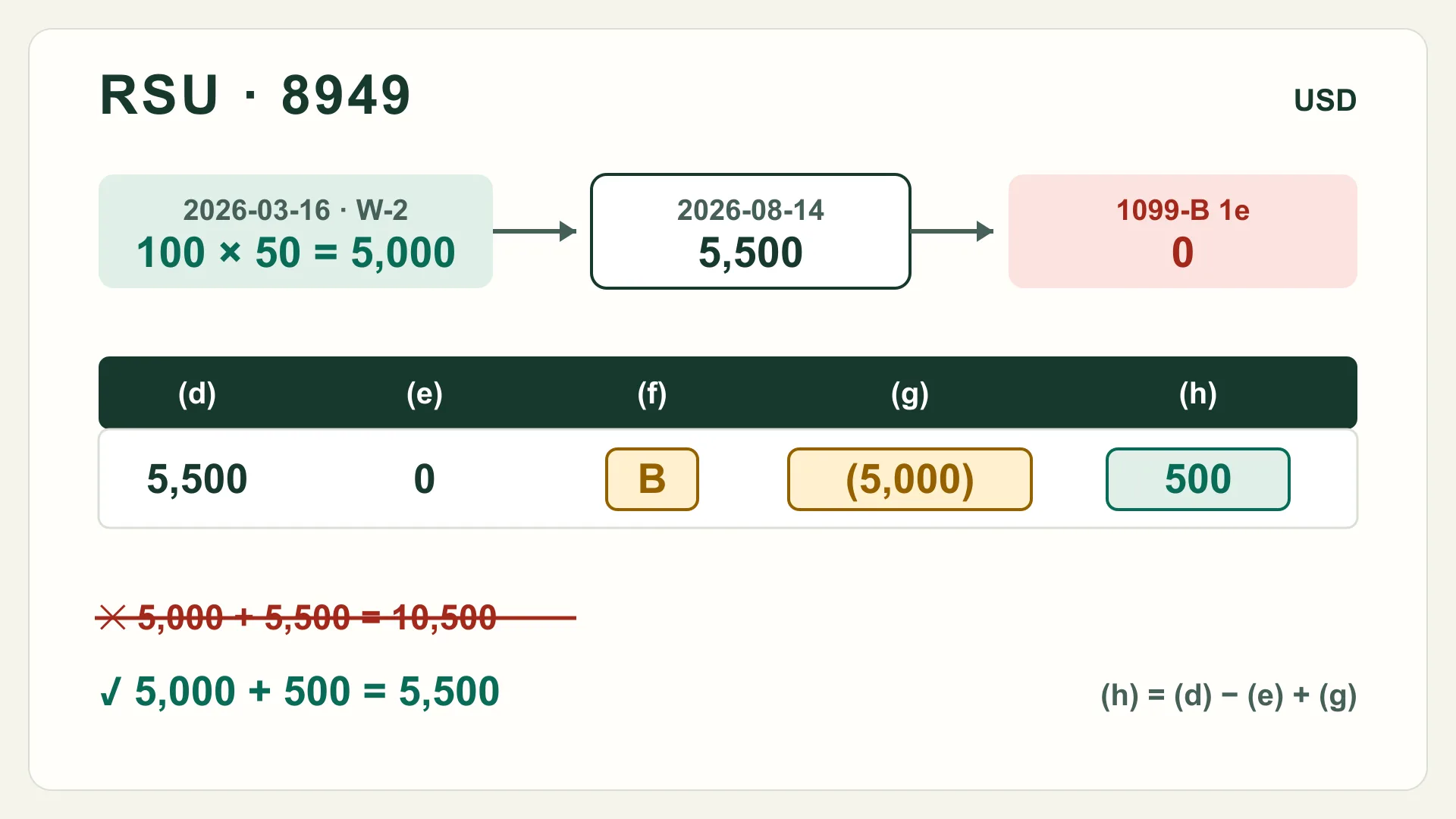
Suppose 100 RSU shares vested on March 16, 2026 at a fair market value of $50 per share, and $5,000 was included in wages. All 100 delivered shares were sold on August 14, 2026 for $5,500 with no fees. The 1099-B shows $0 basis and indicates basis was reported to the IRS, so the sale goes in Part I with box A checked.
| Column | Entry |
|---|---|
| (a) Description | 100 sh XYZ (RSU) |
| (b) Date acquired | 03/16/2026 |
| (c) Date sold | 08/14/2026 |
| (d) Proceeds | 5,500 |
| (e) Cost or other basis | 0 (as shown on 1099-B) |
| (f) Code | B |
| (g) Adjustment | (5,000) |
| (h) Gain or loss | 500 |
Column (h) is (d) − (e) + (g): 5,500 − 0 − 5,000 = 500. Without the adjustment, the line would show a 5,500 gain on top of the 5,000 already in wages, so 10,500 would be taxed for a position that produced 5,500 of total value. With it, the 5,000 is counted once as wages and the 500 of later price change once as a short-term gain.
The IRS's own Example 4 in the Form 8949 instructions follows the same pattern in the opposite direction, where the reported basis was too high and the adjustment is positive.
Step 4: reconcile before you file
Run one check across the whole year: for each RSU lot sold, does vest-date compensation plus reported capital gain or loss equal sale proceeds minus anything you paid? If not, a lot is missing, double-counted, or matched to the wrong vest date. Tax software that imports the 1099-B may need the same code B correction entered by hand.
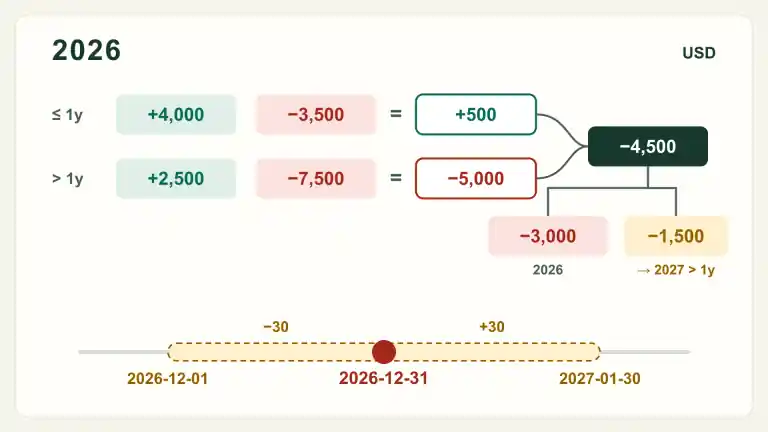
If you also sold ESPP shares, the logic is similar but the compensation amount depends on the type of disposition. The RSU and ESPP basis reconciliation guide covers both plans and the lot ledger. If an RSU sale was at a loss and you acquired more of the same stock within 30 days before or after it, including through an employee plan, review the wash-sale window in the year-end tax-loss harvesting worksheet before finalizing the line.
Turn the page into action
Before you file an RSU sale
- Collect the vest or release confirmation for each lot: date, shares delivered and fair market value.
- Confirm the vesting income appears in your wages for that year.
- Match each 1099-B sale line to its vest lot and holding period.
- Note whether the 1099-B box says basis was reported to the IRS.
- Compute correct basis per lot, including any amount you paid.
- Fill columns (d) to (h) with code B, using the basis-adjustment worksheet if needed.
- Check that wages plus capital gain equal the economic total once, not twice.
- Keep the vest records with the return.
Boundaries
All figures are hypothetical and in U.S. dollars. The procedure follows the 2025 Form 8949 instructions and Publications 525 and 551 as published on IRS.gov; check the versions for the year you file. Section 83(b) or 83(i) elections, private-company stock, nonresident or cross-border work, state sourcing, Puerto Rico residence, and payroll corrections can change the amounts. When wages or vest records look wrong, ask the employer or plan administrator first. This page is not individual tax or legal advice.
Evidence to action
Methods and evidence
Methods used
- Equity-compensation basis
basis = amount paid + compensation income included, subject to the plan and transaction rules - Form 8949 basis adjustment (code B)
if basis reported to IRS: (e) = 1099-B basis, (g) = 1099-B basis − correct basis; else (e) = correct basis, (g) = 0; (h) = (d) − (e) + (g)
Next actions
Structured datasources.jsonformulas.jsonsystems.json
Evidence
Sources
- Instructions for Form 8949
irs-form-8949-instructionsInternal Revenue ServiceAccessedOctober 23, 2026
- Publication 525: Taxable and Nontaxable Income
irs-pub-525Internal Revenue ServiceAccessedOctober 23, 2026
- Publication 551: Basis of Assets
irs-pub-551Internal Revenue ServiceAccessedOctober 23, 2026
- Instructions for Schedule D (Form 1040)
irs-schedule-d-instructionsInternal Revenue ServiceAccessedOctober 23, 2026
Common questions
Frequently asked questions
Why does my 1099-B show $0 cost basis for RSU shares?
The broker may not have included the compensation income recognized when the shares vested. That income is generally already in your wages, so it also forms your basis under the IRS rule that property received for services takes the amount included in income as basis. Check your vest confirmation before filing.
Should I just type the correct basis into column (e)?
Only if the basis was not reported to the IRS (box B or E). If the 1099-B shows the basis was reported to the IRS (box A or D), the Form 8949 instructions say to enter the reported basis in column (e), enter code B in column (f), and put the correction in column (g).
Is the adjustment in column (g) positive or negative?
When the correct basis is higher than the reported basis, the IRS worksheet enters the difference as a negative number in column (g). A higher basis lowers the gain.
Do the shares sold to cover taxes at vesting need to be reported?
If the broker issued a Form 1099-B for those shares, report the sale. Their basis is generally the same vest-date value, so the gain or loss is usually small, but check the actual sale price and fees.